最近几年来,地理信息系统无论是在理论上还是应用上都处在一个飞速发展的阶段。 GIS被应用于多个领域的建模和决策支持,如城市管理、区划、环境整治等等,地理信息成为信息时代重要的组成部分之一; “数字地球”概念的提出,更进一步推动了作为其技术支撑的GIS的发展。 与此同时,一些学者致力于相关的理论研究,如空间感知、空间数据误差、空间关系的形式化等等。 这恰好说明了地理信息系统作为应用技术和学科的两个方面,并且这两个方面构成了相互促进的发展过程。
9.37.1. Brief introduction 
In-application purchases are used by the application to purchase additional content or upgrade features.
9.37.2. Instance step 
1.在 iTunes 连接中请确保拥有一个唯一的 App ID(unique App ID ),当创建捆绑的ID( bundle ID)应用程序更新时,代码会以相应的配置文件签名在Xcode上
two。 Create new applications and update application information. You can learn more about it in Apple’s add new application documentation.
3.在应用程序页的管理应用程序( Manage In-App Purchase)中,为app内付费添加新产品
4.确保设置的应用程序为的银行详细。需要将其设置为在应用程序内购买(In-App purchase)。此外在 iTunes 中使用管理用户(Manage Users)选项,创建一个测试用户帐户连接您的应用程序的页。
5.下一步是与处理代码和为我们在应用程序内购买创建有关的 UI。
6.创建一个单一的视图应用程序,并在 iTunes 中指定的标识符连接输入捆绑标识符
7.更新ViewController.xib ,如下所示
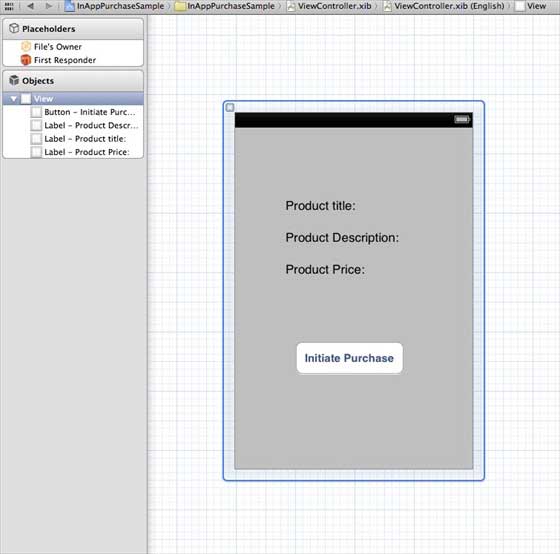
8.为三个标签创建IBOutlets,且将按钮分别命名为 productTitleLabel、 productDescriptionLabel、 productPriceLabel 和 purchaseButton
9.选择项目文件,然后选择目标,然后添加StoreKit.framework
10.更新ViewController.h ,如下所示
#import #import @interface ViewController : UIViewController< SKProductsRequestDelegate,SKPaymentTransactionObserver> { SKProductsRequest *productsRequest; NSArray *validProducts; UIActivityIndicatorView *activityIndicatorView; IBOutlet UILabel *productTitleLabel; IBOutlet UILabel *productDescriptionLabel; IBOutlet UILabel *productPriceLabel; IBOutlet UIButton *purchaseButton; } - (void)fetchAvailableProducts; - (BOOL)canMakePurchases; - (void)purchaseMyProduct:(SKProduct*)product; - (IBAction)purchase:(id)sender; @end 11.更新ViewController.m ,如下所示
#import "ViewController.h" #define kTutorialPointProductID @"com.tutorialPoints.testApp.testProduct" @interface ViewController () @end @implementation ViewController - (void)viewDidLoad { [super viewDidLoad]; // Adding activity indicator activityIndicatorView = [[UIActivityIndicatorView alloc] initWithActivityIndicatorStyle:UIActivityIndicatorViewStyleWhiteLarge]; activityIndicatorView.center = self.view.center; [activityIndicatorView hidesWhenStopped]; [self.view addSubview:activityIndicatorView]; [activityIndicatorView startAnimating]; //Hide purchase button initially purchaseButton.hidden = YES; [self fetchAvailableProducts]; } - (void)didReceiveMemoryWarning { [super didReceiveMemoryWarning]; // Dispose of any resources that can be recreated. } -(void)fetchAvailableProducts{ NSSet *productIdentifiers = [NSSet setWithObjects:kTutorialPointProductID,nil]; productsRequest = [[SKProductsRequest alloc] initWithProductIdentifiers:productIdentifiers]; productsRequest.delegate = self; [productsRequest start]; } - (BOOL)canMakePurchases { return [SKPaymentQueue canMakePayments]; } - (void)purchaseMyProduct:(SKProduct*)product{ if ([self canMakePurchases]) { SKPayment *payment = [SKPayment paymentWithProduct:product]; [[SKPaymentQueue defaultQueue] addTransactionObserver:self]; [[SKPaymentQueue defaultQueue] addPayment:payment]; } else{ UIAlertView *alertView = [[UIAlertView alloc]initWithTitle: @"Purchases are disabled in your device" message:nil delegate: self cancelButtonTitle:@"Ok" otherButtonTitles: nil]; [alertView show]; } } -(IBAction)purchase:(id)sender{ [self purchaseMyProduct:[validProducts objectAtIndex:0]]; purchaseButton.enabled = NO; } #pragma mark StoreKit Delegate -(void)paymentQueue:(SKPaymentQueue *)queue updatedTransactions:(NSArray *)transactions { for (SKPaymentTransaction *transaction in transactions) { switch (transaction.transactionState) { case SKPaymentTransactionStatePurchasing: NSLog(@"Purchasing"); break; case SKPaymentTransactionStatePurchased: if ([transaction.payment.productIdentifier isEqualToString:kTutorialPointProductID]) { NSLog(@"Purchased "); UIAlertView *alertView = [[UIAlertView alloc]initWithTitle: @"Purchase is completed succesfully" message:nil delegate: self cancelButtonTitle:@"Ok" otherButtonTitles: nil]; [alertView show]; } [[SKPaymentQueue defaultQueue] finishTransaction:transaction]; break; case SKPaymentTransactionStateRestored: NSLog(@"Restored "); [[SKPaymentQueue defaultQueue] finishTransaction:transaction]; break; case SKPaymentTransactionStateFailed: NSLog(@"Purchase failed "); break; default: break; } } } -(void)productsRequest:(SKProductsRequest *)request didReceiveResponse:(SKProductsResponse *)response { SKProduct *validProduct = nil; int count = [response.products count]; if (count>0) { validProducts = response.products; validProduct = [response.products objectAtIndex:0]; if ([validProduct.productIdentifier isEqualToString:kTutorialPointProductID]) { [productTitleLabel setText:[NSString stringWithFormat: @"Product Title: %@",validProduct.localizedTitle]]; [productDescriptionLabel setText:[NSString stringWithFormat: @"Product Desc: %@",validProduct.localizedDescription]]; [productPriceLabel setText:[NSString stringWithFormat: @"Product Price: %@",validProduct.price]]; } } else { UIAlertView *tmp = [[UIAlertView alloc] initWithTitle:@"Not Available" message:@"No products to purchase" delegate:self cancelButtonTitle:nil otherButtonTitles:@"Ok", nil]; [tmp show]; } [activityIndicatorView stopAnimating]; purchaseButton.hidden = NO; } @end
注意: You need to modify the kTutorialPointProductID in which you created In-App Pur (purchased in app). You can add multiple products by modifying the NSSet of the fetchAvailableProducts product identifier.
9.37.3. Output 
Run the application, and the output is as follows
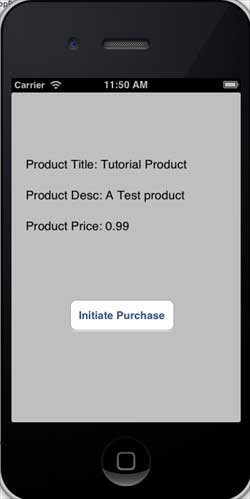
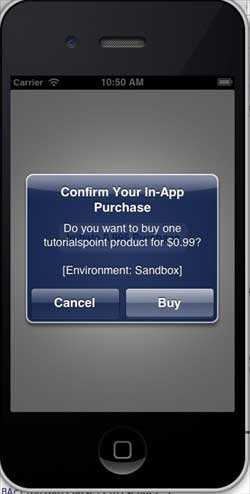
Make sure you are logged in. Click Buy to select an existing Apple ID. Enter a valid user name and password for the test account. After a few seconds, the following information is displayed
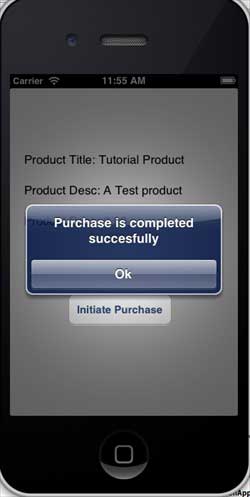
Once the product is purchased successfully, the following information will be obtained. You can update the code related to the application function where this information is displayed
-
1. Angularjs2
8
-
1. SVG tutorial
19
-
1. Memcached
20
-
1. C# tutorial
61
-
1. Sqlite
47
-
2. Go
43
-
2. Docker
59
-
2. Vue3
19
-
2. Servlet
21
-
3. React
23
-
3. SOAP tutorial
10
-
3. Android
18
-
3. Mongodb
44
-
3. Kotlin
18
-
4. Lua
31
-
4. MySQL tutorial
35
-
4. Appml
12
-
5. Perl
45
-
5. Postgresql
41
-
web
15
-
5. Web Services tutorial
6
-
6. Ruby
42
-
6. Design-pattern
35
-
7. Django
18
-
7. Rust
22
-
6. WSDL tutorial
8
-
8. Foundation
39
-
9. Ios
43
-
9.22. The use of IOS View switching
-
9.5. Create the first iPhone application
-
9.19. Use of table view
-
9.33. IOS sends email
-
9.31. IOS positioning operation
-
9.28. IOS accelerometer (accelerometer)
-
9.7. Delegate (Delegates) example
-
>
9.37. In-app purchase of IOS
-
9.40. IOS storyboard (Storyboards)
-
9.10. Why use different input types?
-
8. Css3
26
-
9. Swift
44
-
11. HTML tutorial-(HTML5 Standard)
54
-
12. Http
6
-
13. Regex
6
-
14. Regexp
8
-
1. Introduction to geographic information system
6
-
2. From the Real World to the Bit World
3
-
3. Spatial Data Model
7
-
4. 空间参照系统和 地图投影
5
-
5. Data in GIS
3
-
6. Spatial data acquisition
2
-
7. Spatial Data Management
6
-
8. Spatial analysis
8
-
9. 数字地形模型( DTM )与地形分析
5
-
10. 空间建模与 空间决策支持
6
-
11. Spatial data representation and map making
6
-
12. 3S Integration Technology
5
-
13. 网络地理信息系统
3
-
14. Examples of Geographic Information System Application
8
-
15. Organization and Management of Geographic Information System Application Projects
9
-
16. Geographic Information system Software Engineering Technology
6
-
17. Geographic Information System Standards
3
-
18. Geographic Information System and Society
3
-
19. Earth Information Science and Digital Earth
3