The goto statement in the Go language can be unconditionally transferred to the specified line in the procedure.
goto statements are usually used in conjunction with conditional statements. It can be used to realize the function of conditional transfer, forming a cycle, jumping out of the loop body and so on.
However, it is generally not recommended to use the The flow chart of the goto statement is as follows: In variables The execution result of the above example is: goto statement to avoid confusion in the program flow and make it difficult to understand and debug the program. 2.28.1. Grammar #
goto syntax format is as follows:goto label; .. . label: statement;
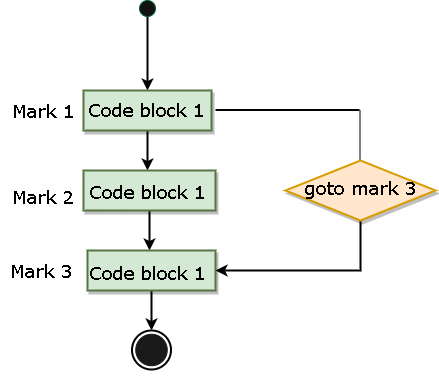
2.28.2. Example #
a equal to 15 skip the loop and go back to the start statement of the loop LOOP :Example #
package main import "fmt" func main() { /* Define local variables */ var a int = 10 /* circulate */ LOOP: for a < 20 { if a == 15 { /* Skip Iteration */ a = a + 1 goto LOOP } fmt.Printf("The value of a is : %d\\n", a) a++ } }
The value of a is: 10 The value of a is: 11 The value of a is: 12 The value of a is: 13 The value of a is: 14 The value of a is: 16 The value of a is: 17 The value of a is: 18 The value of a is: 19