
Calculation attribute keywords: computed .
Computational attributes are useful when dealing with some complex logic.
Take a look at the following example of reversing a string: In example 1, the template becomes very complex and not easy to understand. Next, let’s take a look at an example that uses calculated properties: Original String:
{{ message }} Invert string after calculation: {{ reversedMessage
}} A calculation property is declared in example 2 The function provided will be used as a property We can use It can be said to use Judging from the running results of the instance, when running vm.site = ‘rookie tutorial http://www.runoob.com ’;
In recent years, Geographic Information Systems (GIS) have undergone rapid development in both theoretical and practical dimensions. GIS has been widely applied for modeling and decision-making support across various fields such as urban management, regional planning, and environmental remediation, establishing geographic information as a vital component of the information era. The introduction of the “Digital Earth” concept has further accelerated the advancement of GIS, which serves as its technical foundation. Concurrently, scholars have been dedicated to theoretical research in areas like spatial cognition, spatial data uncertainty, and the formalization of spatial relationships. This reflects the dual nature of GIS as both an applied technology and an academic discipline, with the two aspects forming a mutually reinforcing cycle of progress. 2.11.1. Example 1 
<divid="app">{{ message.split('').reverse().join('') }}div>
2.11.2. Example 2 
reversedMessage . vm.reversedMessage of getter . vm.reversedMessage depend on vm.message in vm.message when there is a change vm.reversedMessage will also be updated. Computed vs methods 
methods to replace computed both of them are the same in effect, but computed is based on its dependency cache and will only be re-valued when the dependency changes. And use methods when re-rendering, the function is always called again to execute
2.11.3. Example 3 
methods:{reversedMessage2:function(){returnthis.message.split('').reverse().join('')}}
computed performance will be better, but if you don’t want caching, you can use the methods property. Computed setter 
computed property defaults to only getter but you can also provide one when needed setter : 2.11.4. Example 4 
varvm=newVue({el:'#app',data:{name:'Google',url:'http://www.google.com'},computed:{site:{//getterget:function(){returnthis.name+''+this.url},//setterset:function(newValue){varnames=newValue.split('')this.name=names[0]this.url=names[names.length-1]}}}})//call
setter, vm.name and vm.url will also be updated accordingly with vm. site='Rookie Tutorial'
http://www.runoob.com';document.write('name:'+vm.name);document.write('
');document.write('url:'+vm.url);
setter will be called. vm.name and vm.url will also be updated accordingly. 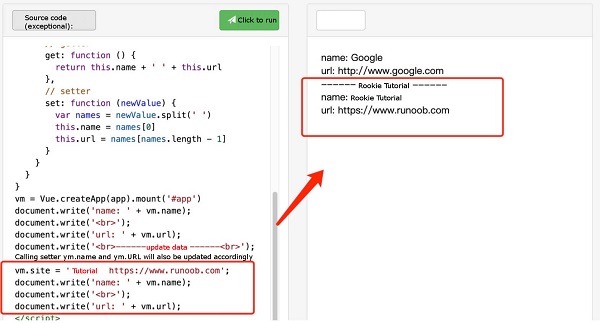
Principles, Technologies, and Methods of Geographic Information Systems
102