最近几年来,地理信息系统无论是在理论上还是应用上都处在一个飞速发展的阶段。 GIS被应用于多个领域的建模和决策支持,如城市管理、区划、环境整治等等,地理信息成为信息时代重要的组成部分之一; “数字地球”概念的提出,更进一步推动了作为其技术支撑的GIS的发展。 与此同时,一些学者致力于相关的理论研究,如空间感知、空间数据误差、空间关系的形式化等等。 这恰好说明了地理信息系统作为应用技术和学科的两个方面,并且这两个方面构成了相互促进的发展过程。
3.27.1. Environment configuration 
If you want to use MongoDB in the Java program, you need to make sure that the Java environment and the MongoDB JDBC driver are installed.
The example of this chapter is suitable for Mongo version 3.x or above.
You can refer to this site. Java教程 To install the Java program. Now let’s check to see if you have a MongoDB JDBC driver installed.
First you must download the mongo jar package, download address: https://mongodb.github.io/mongo-java-driver/ , please make sure to download the latest version.
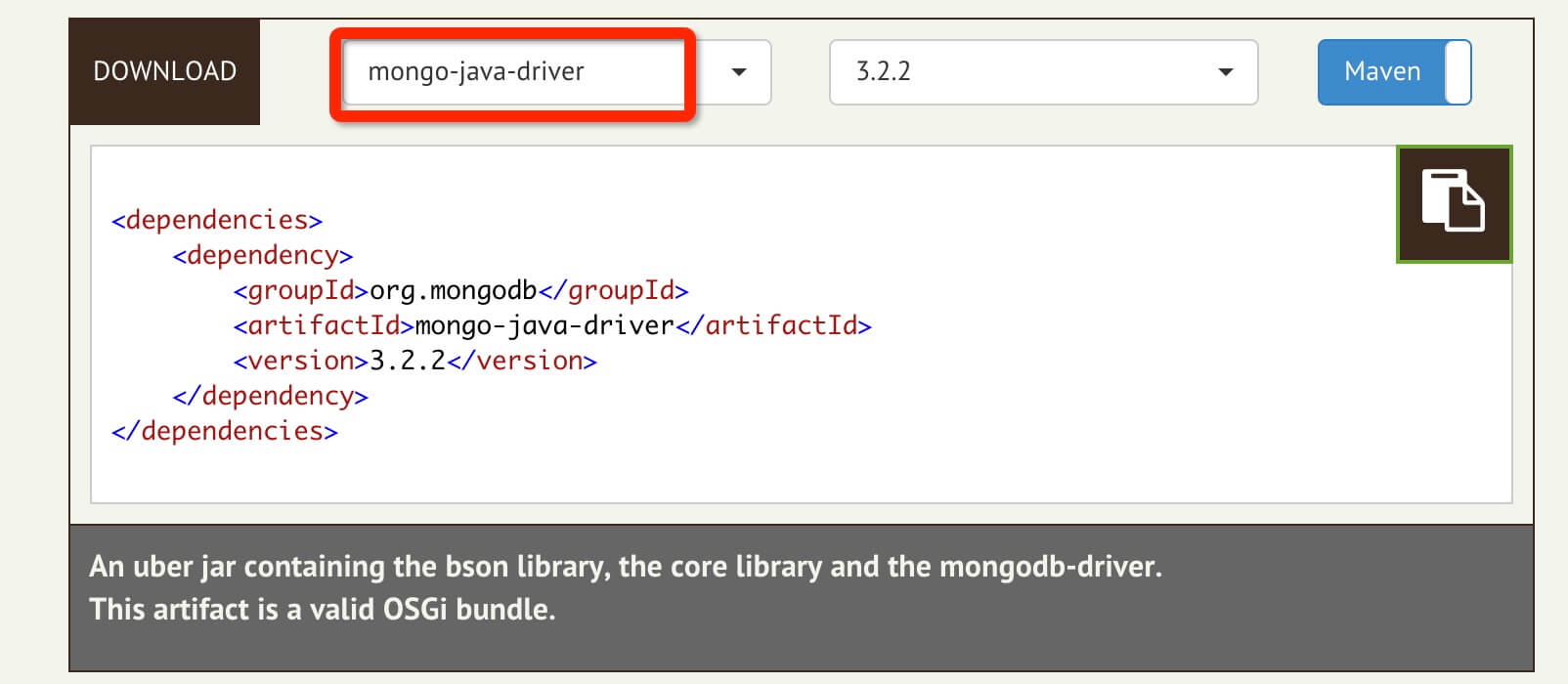
You need to include mongo-java-driver-3.2.2.jar (find the right version) in your classpath.
Domestic mongodb-driver jar download address: http://central.maven.org/maven2/org/mongodb/mongo-java-driver/
3.27.2. Connect to the database 
To connect to a database, you need to specify a database name. If the specified database does not exist, mongo will automatically create the database.
The Java code to connect to the database is as follows:
import com.mongodb.MongoClient; import com.mongodb.client.MongoDatabase; public class MongoDBJDBC{ public static void main( String args[] ){ try{ // 连接到 mongodb 服务 MongoClient mongoClient = new MongoClient( "localhost" , 27017 ); // 连接到数据库 MongoDatabase mongoDatabase = mongoClient.getDatabase("mycol"); System.out.println("Connect to database successfully"); }catch(Exception e){ System.err.println( e.getClass().getName() + ": " + e.getMessage() ); } } } Now let’s compile and run the program and connect to the database mycol.
You can change the path of the MongoDB JDBC driver according to your actual environment.
This example places the MongoDB JDBC startup package mongo-java-driver-3.2.2.jar in the local directory:
$ javac -cp .:mongo-java-driver-3.2.2.jar MongoDBJDBC.java $ java -cp .:mongo-java-driver-3.2.2.jar MongoDBJDBC Connect to database successfully Authentication: true In this example, the Mongo database does not require username and password verification. If your Mongo needs to verify your user name and password, you can use the following code:
import java.util.ArrayList; import java.util.List; import com.mongodb.MongoClient; import com.mongodb.MongoCredential; import com.mongodb.ServerAddress; import com.mongodb.client.MongoDatabase; public class MongoDBJDBC { public static void main(String[] args){ try { //连接到MongoDB服务 如果是远程连接可以替换“localhost”为服务器所在IP地址 //ServerAddress()两个参数分别为 服务器地址 和 端口 ServerAddress serverAddress = new ServerAddress("localhost",27017); List addrs = new ArrayList(); addrs.add(serverAddress); //MongoCredential.createScramSha1Credential()三个参数分别为 用户名 数据库名称 密码 MongoCredential credential = MongoCredential.createScramSha1Credential("username", "databaseName", "password".toCharArray()); List credentials = new ArrayList(); credentials.add(credential); //通过连接认证获取MongoDB连接 MongoClient mongoClient = new MongoClient(addrs,credentials); //连接到数据库 MongoDatabase mongoDatabase = mongoClient.getDatabase("databaseName"); System.out.println("Connect to database successfully"); } catch (Exception e) { System.err.println( e.getClass().getName() + ": " + e.getMessage() ); } } } 3.27.3. Create a collection 
We can use it. com.mongodb.client.MongoDatabase In the class createCollection() To create a collection
The code snippet is as follows:
import com.mongodb.MongoClient; import com.mongodb.client.MongoDatabase; public class MongoDBJDBC{ public static void main( String args[] ){ try{ // 连接到 mongodb 服务 MongoClient mongoClient = new MongoClient( "localhost" , 27017 ); // 连接到数据库 MongoDatabase mongoDatabase = mongoClient.getDatabase("mycol"); System.out.println("Connect to database successfully"); mongoDatabase.createCollection("test"); System.out.println("集合创建成功"); }catch(Exception e){ System.err.println( e.getClass().getName() + ": " + e.getMessage() ); } } }
Compile and run the above program, and the output is as follows:
Connect to database successfully 集合创建成功
3.27.4. Get collection 
We can use it. com.mongodb.client.MongoDatabase Analogous getCollection() Method to get a collection
The code snippet is as follows:
import org.bson.Document; import com.mongodb.MongoClient; import com.mongodb.client.MongoCollection; import com.mongodb.client.MongoDatabase; public class MongoDBJDBC{ public static void main( String args[] ){ try{ // 连接到 mongodb 服务 MongoClient mongoClient = new MongoClient( "localhost" , 27017 ); // 连接到数据库 MongoDatabase mongoDatabase = mongoClient.getDatabase("mycol"); System.out.println("Connect to database successfully"); MongoCollection<Document> collection = mongoDatabase.getCollection("test"); System.out.println("集合 test 选择成功"); }catch(Exception e){ System.err.println( e.getClass().getName() + ": " + e.getMessage() ); } } }
Compile and run the above program, and the output is as follows:
Connect to database successfully 集合 test 选择成功
3.27.5. Insert document 
We can use it. com.mongodb.client.MongoCollection Analogous insertMany() Method to insert a document
The code snippet is as follows:
import java.util.ArrayList; import java.util.List; import org.bson.Document; import com.mongodb.MongoClient; import com.mongodb.client.MongoCollection; import com.mongodb.client.MongoDatabase; public class MongoDBJDBC{ public static void main( String args[] ){ try{ // 连接到 mongodb 服务 MongoClient mongoClient = new MongoClient( "localhost" , 27017 ); // 连接到数据库 MongoDatabase mongoDatabase = mongoClient.getDatabase("mycol"); System.out.println("Connect to database successfully"); MongoCollection<Document> collection = mongoDatabase.getCollection("test"); System.out.println("集合 test 选择成功"); //插入文档 /** * 1. 创建文档 org.bson.Document 参数为key-value的格式 * 2. 创建文档集合List<Document> * 3. 将文档集合插入数据库集合中 mongoCollection.insertMany(List<Document>) 插入单个文档可以用 mongoCollection.insertOne(Document) * */ Document document = new Document("title", "MongoDB"). append("description", "database"). append("likes", 100). append("by", "Fly"); List<Document> documents = new ArrayList<Document>(); documents.add(document); collection.insertMany(documents); System.out.println("文档插入成功"); }catch(Exception e){ System.err.println( e.getClass().getName() + ": " + e.getMessage() ); } } }
Compile and run the above program, and the output is as follows:
Connect to database successfully 集合 test 选择成功 文档插入成功
3.27.6. Retrieve all documents 
We can use it. com.mongodb.client.MongoCollection In the class find() Method to get all the documents in the collection.
This method returns a cursor, so you need to traverse the cursor.
The code snippet is as follows:
import org.bson.Document; import com.mongodb.MongoClient; import com.mongodb.client.FindIterable; import com.mongodb.client.MongoCollection; import com.mongodb.client.MongoCursor; import com.mongodb.client.MongoDatabase; public class MongoDBJDBC{ public static void main( String args[] ){ try{ // 连接到 mongodb 服务 MongoClient mongoClient = new MongoClient( "localhost" , 27017 ); // 连接到数据库 MongoDatabase mongoDatabase = mongoClient.getDatabase("mycol"); System.out.println("Connect to database successfully"); MongoCollection<Document> collection = mongoDatabase.getCollection("test"); System.out.println("集合 test 选择成功"); //检索所有文档 /** * 1. 获取迭代器FindIterable<Document> * 2. 获取游标MongoCursor<Document> * 3. 通过游标遍历检索出的文档集合 * */ FindIterable<Document> findIterable = collection.find(); MongoCursor<Document> mongoCursor = findIterable.iterator(); while(mongoCursor.hasNext()){ System.out.println(mongoCursor.next()); } }catch(Exception e){ System.err.println( e.getClass().getName() + ": " + e.getMessage() ); } } }
Compile and run the above program, and the output is as follows:
Connect to database successfully 集合 test 选择成功 Document{{_id=56e65fb1fd57a86304fe2692, title=MongoDB, description=database, likes=100, by=Fly}}
3.27.7. Update document 
You can use it. com.mongodb.client.MongoCollection In the class updateMany() Method to update the documents in the collection.
The code snippet is as follows:
import org.bson.Document; import com.mongodb.MongoClient; import com.mongodb.client.FindIterable; import com.mongodb.client.MongoCollection; import com.mongodb.client.MongoCursor; import com.mongodb.client.MongoDatabase; import com.mongodb.client.model.Filters; public class MongoDBJDBC{ public static void main( String args[] ){ try{ // 连接到 mongodb 服务 MongoClient mongoClient = new MongoClient( "localhost" , 27017 ); // 连接到数据库 MongoDatabase mongoDatabase = mongoClient.getDatabase("mycol"); System.out.println("Connect to database successfully"); MongoCollection<Document> collection = mongoDatabase.getCollection("test"); System.out.println("集合 test 选择成功"); //更新文档 将文档中likes=100的文档修改为likes=200 collection.updateMany(Filters.eq("likes", 100), new Document("$set",new Document("likes",200))); //检索查看结果 FindIterable<Document> findIterable = collection.find(); MongoCursor<Document> mongoCursor = findIterable.iterator(); while(mongoCursor.hasNext()){ System.out.println(mongoCursor.next()); } }catch(Exception e){ System.err.println( e.getClass().getName() + ": " + e.getMessage() ); } } }
Compile and run the above program, and the output is as follows:
Connect to database successfully 集合 test 选择成功 Document{{_id=56e65fb1fd57a86304fe2692, title=MongoDB, description=database, likes=200, by=Fly}}
3.27.8. Delete the first document 
To delete the first document in the collection, you first need to use the com.mongodb.DBCollection In the class findOne() Method to get the first document and then use the remove Method to delete.
The code snippet is as follows:
import org.bson.Document; import com.mongodb.MongoClient; import com.mongodb.client.FindIterable; import com.mongodb.client.MongoCollection; import com.mongodb.client.MongoCursor; import com.mongodb.client.MongoDatabase; import com.mongodb.client.model.Filters; public class MongoDBJDBC{ public static void main( String args[] ){ try{ // 连接到 mongodb 服务 MongoClient mongoClient = new MongoClient( "localhost" , 27017 ); // 连接到数据库 MongoDatabase mongoDatabase = mongoClient.getDatabase("mycol"); System.out.println("Connect to database successfully"); MongoCollection<Document> collection = mongoDatabase.getCollection("test"); System.out.println("集合 test 选择成功"); //删除符合条件的第一个文档 collection.deleteOne(Filters.eq("likes", 200)); //删除所有符合条件的文档 collection.deleteMany (Filters.eq("likes", 200)); //检索查看结果 FindIterable<Document> findIterable = collection.find(); MongoCursor<Document> mongoCursor = findIterable.iterator(); while(mongoCursor.hasNext()){ System.out.println(mongoCursor.next()); } }catch(Exception e){ System.err.println( e.getClass().getName() + ": " + e.getMessage() ); } } }
Compile and run the above program, and the output is as follows:
Connect to database successfully 集合 test 选择成功
For more operations, please see: http://mongodb.github.io/mongo-java-driver/3.0/driver/getting-started/quick-tour/
Reference document: http://blog.csdn.net/ererfei/article/details/50857103
-
1. Angularjs2
8
-
1. SVG tutorial
19
-
1. Memcached
20
-
1. C# tutorial
61
-
1. Sqlite
47
-
2. Go
43
-
2. Docker
59
-
2. Vue3
19
-
2. Servlet
21
-
3. React
23
-
3. SOAP tutorial
10
-
3. Android
18
-
3. Mongodb
44
-
3.24. MongoDB fragmentation
-
3.15. MongoDB deletes a document
-
3.31. MongoDB relation
-
3.4. Install MongoDB on Windows platform
-
3.25. MongoDB backup (mongodump) and recovery (mongorestore)
-
3.26. MongoDB monitoring
-
3.21. MongoDB index
-
3.34. MongoDB query analysis
-
3.23. MongoDB replication (replica set)
-
3.6. Install MongoDB on Mac OSX platform
-
3. Kotlin
18
-
4. Lua
31
-
4. MySQL tutorial
35
-
4. Appml
12
-
5. Perl
45
-
5. Postgresql
41
-
web
15
-
5. Web Services tutorial
6
-
6. Ruby
42
-
6. Design-pattern
35
-
7. Django
18
-
7. Rust
22
-
6. WSDL tutorial
8
-
8. Foundation
39
-
9. Ios
43
-
8. Css3
26
-
9. Swift
44
-
11. HTML tutorial-(HTML5 Standard)
54
-
12. Http
6
-
13. Regex
6
-
14. Regexp
8
-
1. Introduction to geographic information system
6
-
2. From the Real World to the Bit World
3
-
3. Spatial Data Model
7
-
4. 空间参照系统和 地图投影
5
-
5. Data in GIS
3
-
6. Spatial data acquisition
2
-
7. Spatial Data Management
6
-
8. Spatial analysis
8
-
9. 数字地形模型( DTM )与地形分析
5
-
10. 空间建模与 空间决策支持
6
-
11. Spatial data representation and map making
6
-
12. 3S Integration Technology
5
-
13. 网络地理信息系统
3
-
14. Examples of Geographic Information System Application
8
-
15. Organization and Management of Geographic Information System Application Projects
9
-
16. Geographic Information system Software Engineering Technology
6
-
17. Geographic Information System Standards
3
-
18. Geographic Information System and Society
3
-
19. Earth Information Science and Digital Earth
3