最近几年来,地理信息系统无论是在理论上还是应用上都处在一个飞速发展的阶段。 GIS被应用于多个领域的建模和决策支持,如城市管理、区划、环境整治等等,地理信息成为信息时代重要的组成部分之一; “数字地球”概念的提出,更进一步推动了作为其技术支撑的GIS的发展。 与此同时,一些学者致力于相关的理论研究,如空间感知、空间数据误差、空间关系的形式化等等。 这恰好说明了地理信息系统作为应用技术和学科的两个方面,并且这两个方面构成了相互促进的发展过程。
Component (Component) is Vue.js one of the most powerful functions.
Components can extend HTML elements to encapsulate reusable code.
The component system allows us to build large applications with independently reusable widgets, and the interface of almost any type of application can be abstracted into a component tree:
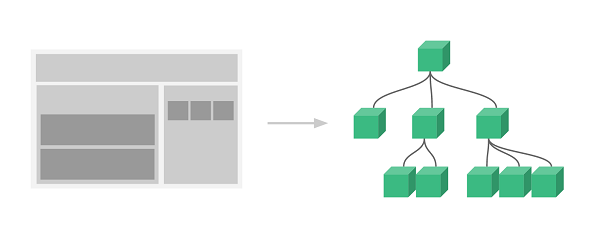
Every one of them. Vue applications are all done by using the createApp function, passed to the createApp is used to configure the root component When we mount the application, this component is used as the starting point for rendering.
An application needs to be mounted into a DOM element.
For the following example, we will Vue the application is mounted to < div id= “app” > < / div > and should be passed in #app :
const RootComponent = { /* option */ } const app = Vue.createApp(RootComponent) const vm = app.mount('#app') The syntax for registering a global component is as follows:
const app = Vue.createApp({...}) app.component('my-component-name', { /* ... */ }) my-component-name is the component name /\* ... \*/ the part is the configuration options. After registration, we can invoke the component in the following ways:
<my-component-name>my-component-name> A simple Vue an example of a component:
2.10.1. Global component instance 
Register a simple global component runoob and use it:
<divid="app"><runoob>runoob>div><script>// Create a Vue application const app = Vue.createApp({}) // Define a new global component called runoob app.component('runoob', { template: 'Custom Components!
' }) app.mount('#app')script> Next, let’s register another one. button-counter component, after each click, the counter will be added by 1:
Example 
// Create a Vue application const app = Vue.createApp({}) // Define a new global component called button counter app.component('button-counter', { data() { return { count: 0 } }, template: \` \` }) app.mount('#app') Note: template is a back quotation mark, not just a quote’.
2.10.2. Reuse of components 
You can reuse the component any number of times:
Example 
<div id="components-demo"> <button-counter>button-counter> <button-counter>button-counter> <button-counter>button-counter> div> 2.10.3. Global component 
In the above examples, our components only pass through the component globally registered.
Globally registered components can be created later in the app used in the instance template, and also in the templates of all subcomponents in theroot instance component tree.
2.10.4. Global component instance 
Register a simple global component runoob and use it:
<divid="app"><runoob>runoob>div><script>// Create a Vue application const app = Vue.createApp({}) // Define a new global component called runoob app.component('runoob', { template: 'Custom Components!
' }) app.mount('#app')script> 2.10.5. Local component 
Global registration is often not ideal. For example, if you use something like webpack in such a build system, registering all components globally means that even if you no longer use a component, it will still be included in your final build result. This has resulted in an unnecessary increase in the number of JavaScript downloaded by users.
In these cases, you can define components through a normal JavaScript object:
const ComponentA = { /* ... */ } const ComponentB = { /* ... */ } const ComponentC = { /* ... */ }
And then in components option to define the components you want to use:
const app = Vue.createApp({ components: { 'component-a': ComponentA, 'component-b': ComponentB } })
For components each attribute in the object, the attribute name is the name of the custom element (component-a, component-b), and the attributevalue is the component’s option object (ComponentA, ComponentB).
We can also register the local component in the instance option so that the component can only be used in this instance:
2.10.6. Local component instance 
Register a simple local component runoobA and use it:
<divid="app"><runoob-a>runoob-a>div><script>var runoobA = { template: 'Custom Components!
' } const app = Vue.createApp({ components: { 'runoob-a': runoobA } }) app.mount('#app')script> 2.10.7. Prop 
prop is a custom property that the child component uses to accept the data passed by the parent component.
The data of the parent component needs to be passed through the props pass data to the subcomponent, which needs to explicitly use the props option declaration “prop”:
Prop instance 
<p> By default, a component can have any number of <code class="docutils literal notranslate"> <span class="pre"> prop </span> </code> any value can be passed to any <code class="docutils literal notranslate"> <span class="pre"> prop </span> </code> . </p>
2.10.8. Dynamic Prop 
Similar to using the v-bind bind the HTML attribute to an expression, or you can use the v-bind dynamic binding props into the data of the parent component Whenever the data of the parent component changes, the change is also transmitted to the child component:
Prop instance 
2.10.9. Prop verification 
Component can be a props specify validation requirements.
In order to customize prop can use the verification method for props provides an object with validation requirements rather than an array of strings. For example:
Vue.component('my-component', { props: { // Basic type check (`null` and `undefined` will pass any type of verification) propA: Number, // Multiple possible types propB: [String, Number], // Required string propC: { type: String, required: true }, // Numbers with default values propD: { type: Number, default: 100 }, // Objects with default values propE: { type: Object, // The default value of an object or array must be obtained from a factory function default: function () { return { message: 'hello' } } }, // Custom validation function propF: { validator: function (value) { // This value must match one of the following strings return ['success', 'warning', 'danger'].indexOf(value) !== -1 } } } }) When prop validation fails, Vue (the build of the development environment) will generate a console warning.
type can be the following native constructor:
-
String
-
Number
-
Boolean
-
Array
-
Object
-
Date
-
Function
-
Symbol
type can also be a custom constructor, using the instanceof test.
-
1. Angularjs2
8
-
1. SVG tutorial
19
-
1. Memcached
20
-
1. C# tutorial
61
-
1. Sqlite
47
-
2. Go
43
-
2. Docker
59
-
2. Vue3
19
-
2.15. Vue3 form
-
2.4. Vue3 creates a project
-
2.5. Vue3 directory structure
-
2.9. Vue.js loop statement
-
2.8. Vue3 conditional statement
-
2.12. Vue3 snooping Properties
-
2.13. Vue3 style binding
-
2.18. Vue3 blending
-
2.11. Vue3 calculation Properties
-
2.16. Vue3 custom instruction
-
2. Servlet
21
-
3. React
23
-
3. SOAP tutorial
10
-
3. Android
18
-
3. Mongodb
44
-
3. Kotlin
18
-
4. Lua
31
-
4. MySQL tutorial
35
-
4. Appml
12
-
5. Perl
45
-
5. Postgresql
41
-
web
15
-
5. Web Services tutorial
6
-
6. Ruby
42
-
6. Design-pattern
35
-
7. Django
18
-
7. Rust
22
-
6. WSDL tutorial
8
-
8. Foundation
39
-
9. Ios
43
-
8. Css3
26
-
9. Swift
44
-
11. HTML tutorial-(HTML5 Standard)
54
-
12. Http
6
-
13. Regex
6
-
14. Regexp
8
-
1. Introduction to geographic information system
6
-
2. From the Real World to the Bit World
3
-
3. Spatial Data Model
7
-
4. 空间参照系统和 地图投影
5
-
5. Data in GIS
3
-
6. Spatial data acquisition
2
-
7. Spatial Data Management
6
-
8. Spatial analysis
8
-
9. 数字地形模型( DTM )与地形分析
5
-
10. 空间建模与 空间决策支持
6
-
11. Spatial data representation and map making
6
-
12. 3S Integration Technology
5
-
13. 网络地理信息系统
3
-
14. Examples of Geographic Information System Application
8
-
15. Organization and Management of Geographic Information System Application Projects
9
-
16. Geographic Information system Software Engineering Technology
6
-
17. Geographic Information System Standards
3
-
18. Geographic Information System and Society
3
-
19. Earth Information Science and Digital Earth
3