
The sequence traversal of the binary search tree, that is, traversing layer by layer, that is, the nodes of each layer are stored in the queue, and then go out of the queue (take out the nodes) and join the queue (the nodes stored in the next layer), so as to achieve the purpose of traversal.
通过引入一个队列来支撑层序遍历:
If the root node is empty, there is no traversal
If the root node is not empty:
Join the root node in the queue first
As long as the queue is not empty:
Leave the first node of the team and traverse
If there is a left child in the first node of the team, the left child will join the team.
If there is a right child in the first node of the team, the right child will join the team.
The following steps are demonstrated in turn:
(1) First take out the root node and put it in the queue.
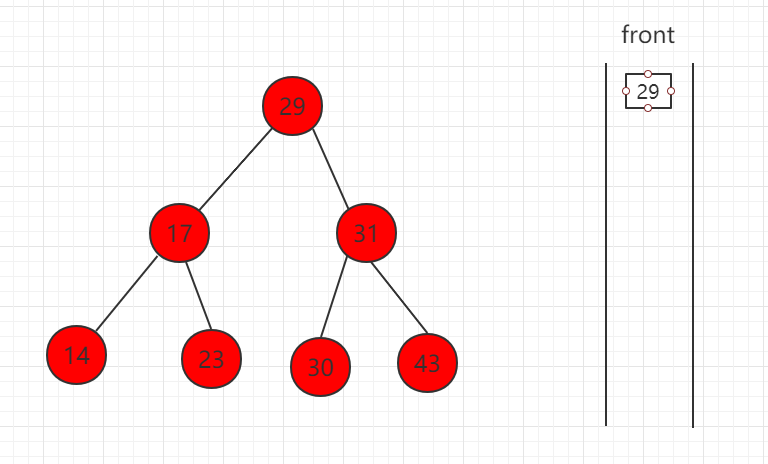
(2) Take out 29, left and right child nodes to join the team.
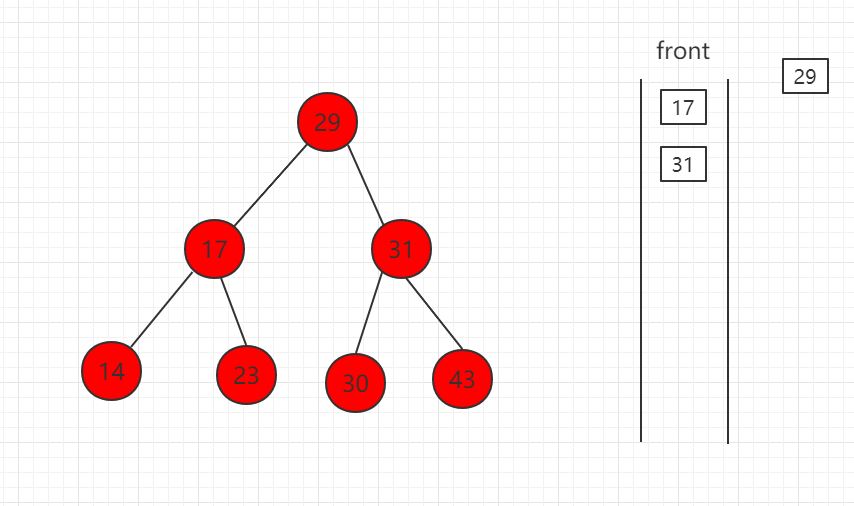
(3) The head of the team is 17 out of the team, and children’s nodes 14 and 23 join the team.
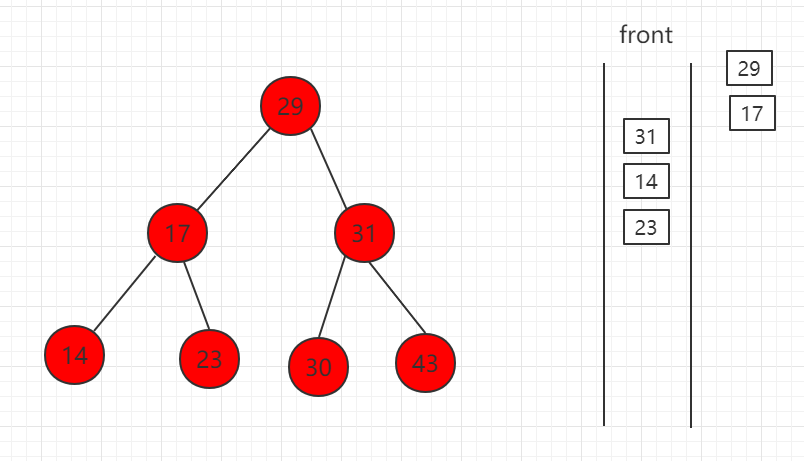
(4) 31 out of the team, children node 30 and 43 join the team
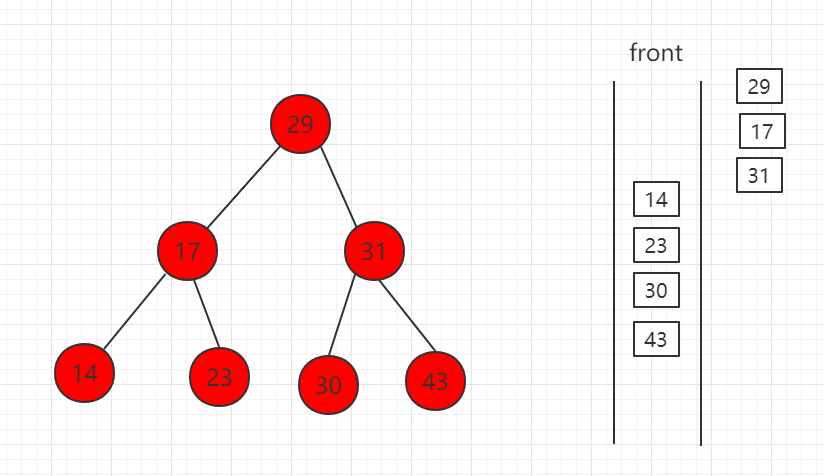
(5) Finally, all came out of the team.
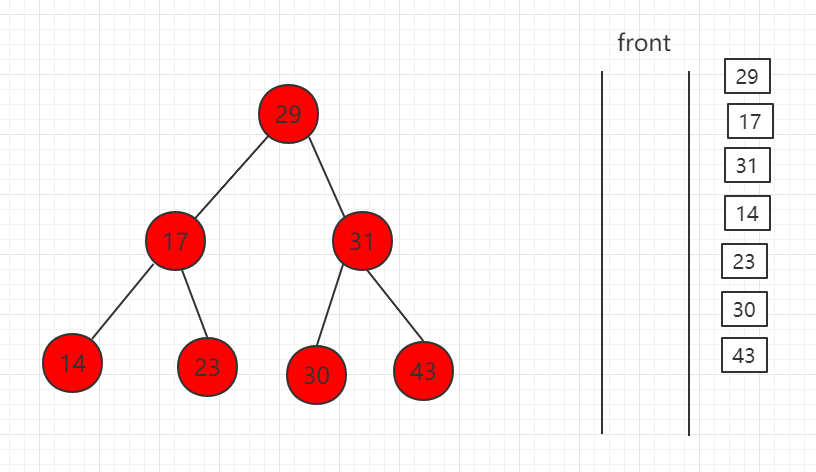
Core code example:
...
// 二分搜索树的层序遍历
public void levelOrder(){
// 我们使用LinkedList来作为我们的队列
LinkedList q = new LinkedList();
q.add(root);
while( !q.isEmpty() ){
Node node = q.remove();
System.out.println(node.key);
if( node.left != null )
q.add( node.left );
if( node.right != null )
q.add( node.right );
}
}
...
5.19.1. Java instance code 
源码包下载: Download
Src/runoob/binary/LevelTraverse.java file code: 
package runoob.binary;
import java.util.LinkedList;
/*\*
\* 层序遍历
*/
public class LevelTraverse, Value>{
// 树中的节点为私有的类, 外界不需要了解二分搜索树节点的具体实现
private class Node {
private Key key;
private Value value;
private Node left, right;
public Node(Key key, Value value) {
this.key = key;
this.value = value;
left = right = null;
}
}
private Node root; // 根节点
private int count; // 树种的节点个数
// 构造函数, 默认构造一棵空二分搜索树
public LevelTraverse() {
root = null;
count = 0;
}
// 返回二分搜索树的节点个数
public int size() {
return count;
}
// 返回二分搜索树是否为空
public boolean isEmpty() {
return count == 0;
}
// 向二分搜索树中插入一个新的(key, value)数据对
public void insert(Key key, Value value){
root = insert(root, key, value);
}
// 查看二分搜索树中是否存在键key
public boolean contain(Key key){
return contain(root, key);
}
// 在二分搜索树中搜索键key所对应的值。如果这个值不存在, 则返回null
public Value search(Key key){
return search( root , key );
}
// 二分搜索树的前序遍历
public void preOrder(){
preOrder(root);
}
// 二分搜索树的中序遍历
public void inOrder(){
inOrder(root);
}
// 二分搜索树的后序遍历
public void postOrder(){
postOrder(root);
}
// 二分搜索树的层序遍历
public void levelOrder(){
// 我们使用LinkedList来作为我们的队列
LinkedList q = new LinkedList();
q.add(root);
while( !q.isEmpty() ){
Node node = q.remove();
System.out.println(node.key);
if( node.left != null )
q.add( node.left );
if( node.right != null )
q.add( node.right );
}
}
//*******************\*
//\* 二分搜索树的辅助函数
//*******************\*
// 向以node为根的二分搜索树中, 插入节点(key, value), 使用递归算法
// 返回插入新节点后的二分搜索树的根
private Node insert(Node node, Key key, Value value){
if( node == null ){
count ++;
return new Node(key, value);
}
if( key.compareTo(node.key) == 0 )
node.value = value;
else if( key.compareTo(node.key) < 0 )
node.left = insert( node.left , key, value);
else // key > node->key
node.right = insert( node.right, key, value);
return node;
}
// 查看以node为根的二分搜索树中是否包含键值为key的节点, 使用递归算法
private boolean contain(Node node, Key key){
if( node == null )
return false;
if( key.compareTo(node.key) == 0 )
return true;
else if( key.compareTo(node.key) < 0 )
return contain( node.left , key );
else // key > node->key
return contain( node.right , key );
}
// 在以node为根的二分搜索树中查找key所对应的value, 递归算法
// 若value不存在, 则返回NULL
private Value search(Node node, Key key){
if( node == null )
return null;
if( key.compareTo(node.key) == 0 )
return node.value;
else if( key.compareTo(node.key) < 0 )
return search( node.left , key );
else // key > node->key
return search( node.right, key );
}
// 对以node为根的二叉搜索树进行前序遍历, 递归算法
private void preOrder(Node node){
if( node != null ){
System.out.println(node.key);
preOrder(node.left);
preOrder(node.right);
}
}
// 对以node为根的二叉搜索树进行中序遍历, 递归算法
private void inOrder(Node node){
if( node != null ){
inOrder(node.left);
System.out.println(node.key);
inOrder(node.right);
}
}
// 对以node为根的二叉搜索树进行后序遍历, 递归算法
private void postOrder(Node node){
if( node != null ){
postOrder(node.left);
postOrder(node.right);
System.out.println(node.key);
}
}
}
-
1. Sqlite
47
-
1. SVG tutorial
19
-
1. C# tutorial
61
-
1. Memcached
20
-
1. Angularjs2
8
-
2. Vue3
19
-
2. Go
43
-
2. Servlet
21
-
2. Docker
59
-
3. React
23
-
3. Kotlin
18
-
3. Mongodb
44
-
3. Android
18
-
3. SOAP tutorial
10
-
4. Lua
31
-
4. Appml
12
-
4. MySQL tutorial
34
-
5. Perl
45
-
web
15
-
5. Postgresql
41
-
6. Ruby
41
-
5. Web Services tutorial
6
-
6. Design-pattern
35
-
7. Rust
22
-
6. WSDL tutorial
8
-
7. Django
18
-
8. Foundation
39
-
9. Ios
43
-
9. Swift
43
-
8. Css3
26
-
11. HTML tutorial-(HTML5 Standard)
54
-
12. Http
6
-
13. Regex
6
-
14. Regexp
7
-
1. Geographical Information Systems in the World Wide Web Era
4
-
2. Basic technology of WebGIS
4
-
3. Geographic Web Services
5
-
4. aggregation of geographical information
4
-
5. mobile GIS
5
-
6. Geographic information portal
3
-
7. New generation national spatial data infrastructure and GIS
4
-
8. Application of WebGIS in E-Commerce
3
-
9. Application of WebGIS in E-government
3
-
10. Hotspots and frontiers of WebGIS
2
Principles, Technologies, and Methods of Geographic Information Systems
102
In recent years, Geographic Information Systems (GIS) have undergone rapid development in both theoretical and practical dimensions. GIS has been widely applied for modeling and decision-making support across various fields such as urban management, regional planning, and environmental remediation, establishing geographic information as a vital component of the information era. The introduction of the “Digital Earth” concept has further accelerated the advancement of GIS, which serves as its technical foundation. Concurrently, scholars have been dedicated to theoretical research in areas like spatial cognition, spatial data uncertainty, and the formalization of spatial relationships. This reflects the dual nature of GIS as both an applied technology and an academic discipline, with the two aspects forming a mutually reinforcing cycle of progress.
-
1. Introduction to Geographic Information Systems
6
-
2. From the Real World to the Bit World
3
-
3. Spatial Data Model
7
-
4. Spatial Reference Systems and Map Projections
5
-
5. Data in GIS
4
-
6. Spatial data acquisition
2
-
7. Spatial Data Management
6
-
8. Spatial analysis
8
-
9. Digital Terrain Model (DTM) and Terrain Analysis
5
-
10. Spatial modeling and spatial decision support
6
-
11. Spatial data representation and map making
6
-
12. 3S Integration Technology
5
-
13. Network Geographic Information System
4
-
14. Examples of Geographic Information System Application
8
-
15. Organization and Management of Geographic Information System Application Projects
10
-
16. Geographic Information system Software Engineering Technology
7
-
17. Geographic Information System Standards
3
-
18. Geographic Information System and Society
3
-
19. Earth Information Science and Digital Earth
4