最近几年来,地理信息系统无论是在理论上还是应用上都处在一个飞速发展的阶段。 GIS被应用于多个领域的建模和决策支持,如城市管理、区划、环境整治等等,地理信息成为信息时代重要的组成部分之一; “数字地球”概念的提出,更进一步推动了作为其技术支撑的GIS的发展。 与此同时,一些学者致力于相关的理论研究,如空间感知、空间数据误差、空间关系的形式化等等。 这恰好说明了地理信息系统作为应用技术和学科的两个方面,并且这两个方面构成了相互促进的发展过程。
The type of keyboard input helps us get the necessary input from the user.
It removes unwanted keys and includes the required parts. Users can set the type of input by using the keyboard properties of UITextField.
For example: text field (textField). KeyboardType = UIKeyboardTypeDefault
Keyboard input type
Type of input | Description |
|---|---|
UIKeyboardTypeASCIICapable | The keyboard includes all standard ASCII? Characters. |
UIKeyboardTypeNumbersAndPunctuation | The keyboard displays numbers and punctuation. |
UIKeyboardTypeURL | Keyboard? URL? Item optimization. |
UIKeyboardTypeNumberPad | The keyboard is used for PIN? Enter and display a numeric keypad. |
UIKeyboardTypePhonePad | The keypad optimizes the input phone number. |
UIKeyboardTypeNamePhonePad | The keyboard is used to enter a name or phone number. |
UIKeyboardTypeEmailAddress | The keyboard optimizes the input email address. |
UIKeyboardTypeDecimalPad | The keyboard is used to enter decimal numbers. |
UIKeyboardTypeTwitter | Keyboard pair? twitter @? And? The symbol is optimized. |
9.10.1. Add a custom method addTextFieldWithDifferentKeyboard 
-(void) addTextFieldWithDifferentKeyboard{

   UITextField *textField1= [[UITextField alloc]initWithFrame:
   CGRectMake(20, 50, 280, 30)];
   textField1.delegate = self;
   textField1.borderStyle = UITextBorderStyleRoundedRect;
   textField1.placeholder = @"Default Keyboard";
   [self.view addSubview:textField1];

   UITextField *textField2 = [[UITextField alloc]initWithFrame:
   CGRectMake(20, 100, 280, 30)];
   textField2.delegate = self;
   textField2.borderStyle = UITextBorderStyleRoundedRect;
   textField2.keyboardType = UIKeyboardTypeASCIICapable;
   textField2.placeholder = @"ASCII keyboard";
   [self.view addSubview:textField2];

   UITextField *textField3 = [[UITextField alloc]initWithFrame:
   CGRectMake(20, 150, 280, 30)];
   textField3.delegate = self;
   textField3.borderStyle = UITextBorderStyleRoundedRect;
   textField3.keyboardType = UIKeyboardTypePhonePad;
   textField3.placeholder = @"Phone pad keyboard";
   [self.view addSubview:textField3];

   UITextField *textField4 = [[UITextField alloc]initWithFrame:
   CGRectMake(20, 200, 280, 30)];
   textField4.delegate = self;
   textField4.borderStyle = UITextBorderStyleRoundedRect;
   textField4.keyboardType = UIKeyboardTypeDecimalPad;
   textField4.placeholder = @"Decimal pad keyboard";
   [self.view addSubview:textField4];

   UITextField *textField5= [[UITextField alloc]initWithFrame:
   CGRectMake(20, 250, 280, 30)];
   textField5.delegate = self;
   textField5.borderStyle = UITextBorderStyleRoundedRect;
   textField5.keyboardType = UIKeyboardTypeEmailAddress;
   textField5.placeholder = @"Email keyboard";
   [self.view addSubview:textField5];

   UITextField *textField6= [[UITextField alloc]initWithFrame:
   CGRectMake(20, 300, 280, 30)];
   textField6.delegate = self;
   textField6.borderStyle = UITextBorderStyleRoundedRect;
   textField6.keyboardType = UIKeyboardTypeURL;
   textField6.placeholder = @"URL keyboard";
   [self.view addSubview:textField6];
}
Update viewDidLoad in ViewController.m, as shown below
(void)viewDidLoad
{
   [super viewDidLoad];
   //The custom method to create textfield with different keyboard input
   [self addTextFieldWithDifferentKeyboard];
   //Do any additional setup after loading the view, typically from a nib
}
Output 
Now when we run the application, we get the following output:
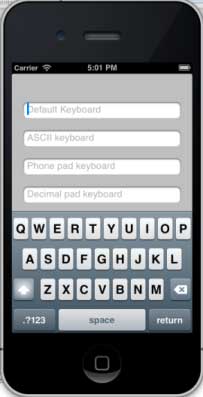
Select different text areas and we will see different keyboards.