最近几年来,地理信息系统无论是在理论上还是应用上都处在一个飞速发展的阶段。 GIS被应用于多个领域的建模和决策支持,如城市管理、区划、环境整治等等,地理信息成为信息时代重要的组成部分之一; “数字地球”概念的提出,更进一步推动了作为其技术支撑的GIS的发展。 与此同时,一些学者致力于相关的理论研究,如空间感知、空间数据误差、空间关系的形式化等等。 这恰好说明了地理信息系统作为应用技术和学科的两个方面,并且这两个方面构成了相互促进的发展过程。
9.31.1. Brief introduction 
Through CoreLocation positioning in IOS, the current location of the user can be obtained, and the device movement information can be obtained at the same time.
9.31.2. Instance step 
1、创建一个简单的View based application(视图应用程序)。
2、择项目文件,然后选择目标,然后添加CoreLocation.framework,如下所示
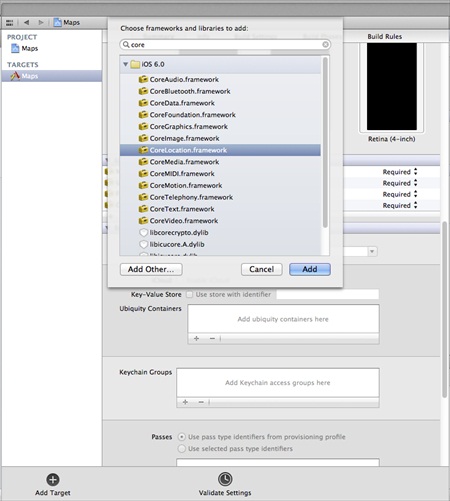
3、在ViewController.xib中添加两个标签,创建ibOutlet名为latitudeLabel和longtitudeLabel的标签
4、现在通过选择” File-> New -> File… -> “选择Objective C class 并单击下一步
5、把”sub class of”作为NSObject,将类命名为LocationHandler
6、选择创建
7、更新LocationHandler.h,如下所示
#import #import @protocol LocationHandlerDelegate <NSObject> @required -(void) didUpdateToLocation:(CLLocation*)newLocation fromLocation:(CLLocation*)oldLocation; @end @interface LocationHandler : NSObject<CLLocationManagerDelegate> { CLLocationManager *locationManager; } @property(nonatomic,strong) id<LocationHandlerDelegate> delegate; +(id)getSharedInstance; -(void)startUpdating; -(void) stopUpdating; @end 8、更新LocationHandler.m,如下所示
#import "LocationHandler.h" static LocationHandler *DefaultManager = nil; @interface LocationHandler() -(void)initiate; @end @implementation LocationHandler +(id)getSharedInstance{ if (!DefaultManager) { DefaultManager = [[self allocWithZone:NULL]init]; [DefaultManager initiate]; } return DefaultManager; } -(void)initiate{ locationManager = [[CLLocationManager alloc]init]; locationManager.delegate = self; } -(void)startUpdating{ [locationManager startUpdatingLocation]; } -(void) stopUpdating{ [locationManager stopUpdatingLocation]; } -(void)locationManager:(CLLocationManager *)manager didUpdateToLocation: (CLLocation *)newLocation fromLocation:(CLLocation *)oldLocation{ if ([self.delegate respondsToSelector:@selector (didUpdateToLocation:fromLocation:)]) { [self.delegate didUpdateToLocation:oldLocation fromLocation:newLocation]; } } @end 9、更新ViewController.h,如下所示
#import #import "LocationHandler.h" @interface ViewController : UIViewController<LocationHandlerDelegate> { IBOutlet UILabel *latitudeLabel; IBOutlet UILabel *longitudeLabel; } @end 10、更新ViewController.m,如下所示
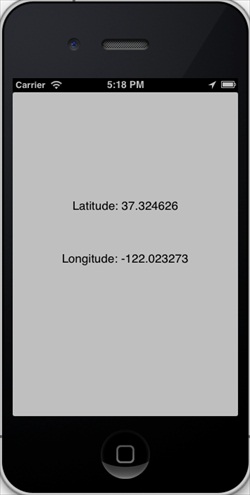
#import "ViewController.h" @interface ViewController () @end @implementation ViewController - (void)viewDidLoad { [super viewDidLoad]; [[LocationHandler getSharedInstance]setDelegate:self]; [[LocationHandler getSharedInstance]startUpdating]; } - (void)didReceiveMemoryWarning { [super didReceiveMemoryWarning]; // Dispose of any resources that can be recreated. } -(void)didUpdateToLocation:(CLLocation *)newLocation fromLocation:(CLLocation *)oldLocation{ [latitudeLabel setText:[NSString stringWithFormat: @"Latitude: %f",newLocation.coordinate.latitude]]; [longitudeLabel setText:[NSString stringWithFormat: @"Longitude: %f",newLocation.coordinate.longitude]]; } @end
9.31.3. Output 
When we run the application, we get the following output:
-
1. Angularjs2
8
-
1. SVG tutorial
19
-
1. Memcached
20
-
1. C# tutorial
61
-
1. Sqlite
47
-
2. Go
43
-
2. Docker
59
-
2. Vue3
19
-
2. Servlet
21
-
3. React
23
-
3. SOAP tutorial
10
-
3. Android
18
-
3. Mongodb
44
-
3. Kotlin
18
-
4. Lua
31
-
4. MySQL tutorial
35
-
4. Appml
12
-
5. Perl
45
-
5. Postgresql
41
-
web
15
-
5. Web Services tutorial
6
-
6. Ruby
42
-
6. Design-pattern
35
-
7. Django
18
-
7. Rust
22
-
6. WSDL tutorial
8
-
8. Foundation
39
-
9. Ios
43
-
9.22. The use of IOS View switching
-
9.5. Create the first iPhone application
-
9.19. Use of table view
-
9.33. IOS sends email
-
>
9.31. IOS positioning operation
-
9.28. IOS accelerometer (accelerometer)
-
9.7. Delegate (Delegates) example
-
9.37. In-app purchase of IOS
-
9.40. IOS storyboard (Storyboards)
-
9.10. Why use different input types?
-
8. Css3
26
-
9. Swift
44
-
11. HTML tutorial-(HTML5 Standard)
54
-
12. Http
6
-
13. Regex
6
-
14. Regexp
8
-
1. Introduction to geographic information system
6
-
2. From the Real World to the Bit World
3
-
3. Spatial Data Model
7
-
4. 空间参照系统和 地图投影
5
-
5. Data in GIS
3
-
6. Spatial data acquisition
2
-
7. Spatial Data Management
6
-
8. Spatial analysis
8
-
9. 数字地形模型( DTM )与地形分析
5
-
10. 空间建模与 空间决策支持
6
-
11. Spatial data representation and map making
6
-
12. 3S Integration Technology
5
-
13. 网络地理信息系统
3
-
14. Examples of Geographic Information System Application
8
-
15. Organization and Management of Geographic Information System Application Projects
9
-
16. Geographic Information system Software Engineering Technology
6
-
17. Geographic Information System Standards
3
-
18. Geographic Information System and Society
3
-
19. Earth Information Science and Digital Earth
3