最近几年来,地理信息系统无论是在理论上还是应用上都处在一个飞速发展的阶段。 GIS被应用于多个领域的建模和决策支持,如城市管理、区划、环境整治等等,地理信息成为信息时代重要的组成部分之一; “数字地球”概念的提出,更进一步推动了作为其技术支撑的GIS的发展。 与此同时,一些学者致力于相关的理论研究,如空间感知、空间数据误差、空间关系的形式化等等。 这恰好说明了地理信息系统作为应用技术和学科的两个方面,并且这两个方面构成了相互促进的发展过程。
Maven uses archetype (prototype) to create a custom project structure to form a Maven project template.
In the previous section, we learned that Maven uses the following command to quickly create a java project:
mvn archetype:generate 11.11.1. What is archetype? 
Archetype, or prototype, is a Maven plug-in, to be exact, a project template whose task is to create a project structure based on the template. We will use the quickstart prototype plug-in to create a simple java application.
11.11.2. Use project templates 
Let’s open the command console, jump to the C:> MVN directory and execute the following mvn command:
C:\MVN> mvn archetype:generate Maven will start processing and require you to select the desired prototype:
[INFO] Scanning for projects... [INFO] Searching repository for plugin with prefix: 'archetype'. [INFO] ------------------------------------------------------------------- [INFO] Building Maven Default Project [INFO]task-segment: [archetype:generate] (aggregator-style) [INFO] ------------------------------------------------------------------- [INFO] Preparing archetype:generate ... 600: remote -> org.trailsframework:trails-archetype (-) 601: remote -> org.trailsframework:trails-secure-archetype (-) 602: remote -> org.tynamo:tynamo-archetype (-) 603: remote -> org.wicketstuff.scala:wicket-scala-archetype (-) 604: remote -> org.wicketstuff.scala:wicketstuff-scala-archetype Basic setup for a project that combines Scala and Wicket, depending on the Wicket-Scala project. Includes an example Specs test.) 605: remote -> org.wikbook:wikbook.archetype (-) 606: remote -> org.xaloon.archetype:xaloon-archetype-wicket-jpa-glassfish (-) 607: remote -> org.xaloon.archetype:xaloon-archetype-wicket-jpa-spring (-) 608: remote -> org.xwiki.commons:xwiki-commons-component-archetype (Make it easy to create a maven project for creating XWiki Components.) 609: remote -> org.xwiki.rendering:xwiki-rendering-archetype-macro (Make it easy to create a maven project for creating XWiki Rendering Macros.) 610: remote -> org.zkoss:zk-archetype-component (The ZK Component archetype) 611: remote -> org.zkoss:zk-archetype-webapp (The ZK wepapp archetype) 612: remote -> ru.circumflex:circumflex-archetype (-) 613: remote -> se.vgregion.javg.maven.archetypes:javg-minimal-archetype (-) 614: remote -> sk.seges.sesam:sesam-annotation-archetype (-) Choose a number or apply filter (format: [groupId:]artifactId, case sensitive contains): 203: Press Enter Select the default option (203:maven-archetype-quickstart).
11.11.3. Maven will ask for the version of the prototype 
Choose org.apache.maven.archetypes:maven-archetype-quickstart version: 1: 1.0-alpha-1 2: 1.0-alpha-2 3: 1.0-alpha-3 4: 1.0-alpha-4 5: 1.0 6: 1.1 Choose a number: 6: Press Enter Select the default option (6:maven-archetype-quickstart:1.1)
Maven will ask for project details. Enter project details as required. Press Enter directly if you want to use the default value. You can also enter your own value.
Define value for property 'groupId': : com.companyname.insurance Define value for property 'artifactId': : health Define value for property 'version': 1.0-SNAPSHOT Define value for property 'package': com.companyname.insurance Maven will ask for confirmation of project details, press Enter Or press Y
Confirm properties configuration: groupId: com.companyname.insurance artifactId: health version: 1.0-SNAPSHOT package: com.companyname.insurance Y: Now Maven will begin to create the project structure, which is shown as follows:
[INFO] ----------------------------------------------------------------------- [INFO] Using following parameters for creating project from Old (1.x) Archetype: maven-archetype-quickstart:1.1 [INFO] ----------------------------------------------------------------------- [INFO] Parameter: groupId, Value: com.companyname.insurance [INFO] Parameter: packageName, Value: com.companyname.insurance [INFO] Parameter: package, Value: com.companyname.insurance [INFO] Parameter: artifactId, Value: health [INFO] Parameter: basedir, Value: C:\MVN [INFO] Parameter: version, Value: 1.0-SNAPSHOT [INFO] project created from Old (1.x) Archetype in dir: C:\MVN\health [INFO] ----------------------------------------------------------------------- [INFO] BUILD SUCCESSFUL [INFO] ----------------------------------------------------------------------- [INFO] Total time: 4 minutes 12 seconds [INFO] Finished at: Fri Jul 13 11:10:12 IST 2012 [INFO] Final Memory: 20M/90M [INFO] ----------------------------------------------------------------------- 11.11.4. Project created 
Now go to the C:> MVN directory. You will see a java application project named health, just like the artifactId name created when the project was created. Maven will create a project with a standard directory layout, as follows:
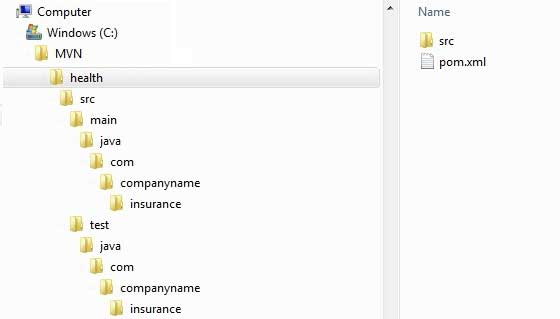
11.11.5. Create pom.xml 
Maven automatically generates a pom.xml file for the project, as shown below:
<projectxmlns="http://maven.apache.org/POM/4.0.0"xmlns:xsi="http://www.w3.org/2001/XMLSchema-instance"xsi:schemaLocation="http://maven.apache.org/POM/4.0.0 http://maven.apache.org/xsd/maven-4.0.0.xsd">4.0.0 com.companyname.insurance health 1.0-SNAPSHOT jar health http://maven.apache.org UTF-8 junit junit 3.8.1 test 11.11.6. App.java 
Maven automatically generates a test java file, App.java.
路径: C:MVNconsumerBankingsrcmainjavacomcompanynamebank
packagecom.companyname.insurance;/\*\* \* Hello world! \*\*/publicclassApp{publicstaticvoidmain(String[]args){System.out.println("Hello World!");}} 11.11.7. AppTest.java 
Maven automatically generates a java file, AppTest.java.
路径为: C:MVNconsumerBankingsrctestjavacomcompanynamebank
packagecom.companyname.insurance;importjunit.framework.Test;importjunit.framework.TestCase;importjunit.framework.TestSuite;/\*\* \* Unit test for simple App.\*/publicclassAppTestextendsTestCase{/\*\* \* Create the test case \* \*@paramtestName name of the test case\*/publicAppTest(StringtestName){super(testName);}/\*\* \*@returnthe suite of tests being tested\*/publicstaticTestsuite(){returnnewTestSuite(AppTest.class);}/\*\* \* Rigourous Test :-)\*/publicvoidtestApp(){assertTrue(true);}} That’s all. Now you can see the power of Maven. You can create any type of project with maven simple commands, and you can start your development.