最近几年来,地理信息系统无论是在理论上还是应用上都处在一个飞速发展的阶段。 GIS被应用于多个领域的建模和决策支持,如城市管理、区划、环境整治等等,地理信息成为信息时代重要的组成部分之一; “数字地球”概念的提出,更进一步推动了作为其技术支撑的GIS的发展。 与此同时,一些学者致力于相关的理论研究,如空间感知、空间数据误差、空间关系的形式化等等。 这恰好说明了地理信息系统作为应用技术和学科的两个方面,并且这两个方面构成了相互促进的发展过程。
The Maven build life cycle defines a project build and release process.
A typical Maven build (build) life cycle consists of a sequence of the following phases:
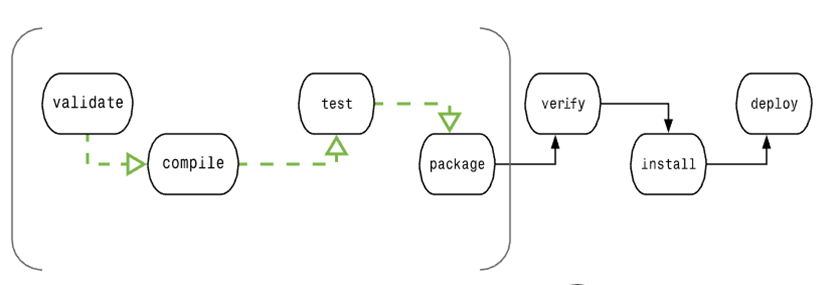
Stage | Deal with | Description |
|---|---|---|
Verify validate | Validate the project | Verify that the project is correct and that all required information is available |
Compile compile | Perform compilation | Source code compilation is completed at this stage |
Test Test | test | Run the tests using the appropriate unit test framework, such as JUnit. |
Packaging package | Packing | Create JAR/WAR packages such as those mentioned in the definition of pom.xml |
Check verify | Check | Check the results of the integration test to ensure that the quality is up to standard |
Install install | Installation | Install the packaged project to the local warehouse for use by other projects |
Deploy deploy | Deployment | Copy the final project package to the remote warehouse to share with other developers and projects |
In order to complete the default lifecycle, these phases (including other lifecycle phases not listed above) will be executed sequentially.
Maven has three standard lifecycles:
clean : handling of project cleanup
default(或 build) Processing of project deployment
site Processing of project site document creation
11.4.1. The build phase consists of plug-in goals. 
A plug-in goal represents a specific task (more refined than the build phase), which helps build and manage the project. These goals may be bound to multiple phases or unbound. Goals that are not bound to any build phase can be executed through direct calls outside the build life cycle. The order in which these goals are executed depends on the order of the invocation target and the build phase.
For example, consider the following command:
Clean and pakage are the construction phase, and dependency:copy-dependencies is the target
mvn clean dependency:copy-dependencies package The clean phase here will be executed first, then the dependency:copy-dependencies goal will be executed, and finally the package phase will be executed.
11.4.2. Clean lifecycle 
When we execute the mvn post-clean command, Maven calls the clean lifecycle, which consists of the following phases:
Pre-clean: perform some work that needs to be done before clean
Clean: removes all files generated by the last build
Post-clean: perform some work that needs to be done immediately after clean
The clean in mvn clean is the clean above. In a lifecycle, when you run a phase, all previous phases are run, that is, if you execute mvn clean, you will run the following two lifecycle phases:
pre-clean, clean If we run mvn post-clean, we run the following three lifecycle phases:
pre-clean, clean, post-clean We can modify the operational behavior of this part by defining goals at any stage of the clean lifecycle above.
In the following example, we add the maven-antrun-plugin:run target to the pre-clean, clean, and post-clean phases. This allows us to display text messages at all stages of the clean lifecycle.
We have created a pom.xml file in the C:MVNproject directory.
<projectxmlns="http://maven.apache.org/POM/4.0.0"xmlns:xsi="http://www.w3.org/2001/XMLSchema-instance"xsi:schemaLocation="http://maven.apache.org/POM/4.0.0 http://maven.apache.org/xsd/maven-4.0.0.xsd">4.0.0 com.companyname.projectgroup project 1.0 org.apache.maven.plugins maven-antrun-plugin 1.1 id.pre-clean pre-clean run pre-clean phaseecho>tasks>configuration>execution><execution><id>id.cleanid><phase>cleanphase><goals><goal>rungoal>goals><configuration><tasks><echo>clean phaseecho>tasks>configuration>execution><execution><id>id.post-cleanid><phase>post-cleanphase><goals><goal>rungoal>goals><configuration><tasks><echo>post-clean phaseecho>tasks>configuration>execution>executions>plugin>plugins>build>project> Now open the command console, jump to the directory where pom.xml is located, and execute the following mvn command.
C:\MVN\project>mvn post-clean
Maven will begin to process and display all phases of the clean life cycle.
[INFO] Scanning for projects... [INFO] ------------------------------------------------------------------ [INFO] Building Unnamed - com.companyname.projectgroup:project:jar:1.0 [INFO] task-segment: [post-clean] [INFO] ------------------------------------------------------------------ [INFO] [antrun:run {execution: id.pre-clean}] [INFO] Executing tasks [echo] pre-clean phase [INFO] Executed tasks [INFO] [clean:clean {execution: default-clean}] [INFO] [antrun:run {execution: id.clean}] [INFO] Executing tasks [echo] clean phase [INFO] Executed tasks [INFO] [antrun:run {execution: id.post-clean}] [INFO] Executing tasks [echo] post-clean phase [INFO] Executed tasks [INFO] ------------------------------------------------------------------ [INFO] BUILD SUCCESSFUL [INFO] ------------------------------------------------------------------ [INFO] Total time: < 1 second [INFO] Finished at: Sat Jul 07 13:38:59 IST 2012 [INFO] Final Memory: 4M/44M [INFO] ------------------------------------------------------------------
You can try to modify the mvn clean command to display pre-clean and clean without doing anything during the post-clean phase.
11.4.3. Default (Build) lifecycle 
This is the main life cycle of Maven and is used to build applications, including the following 23 phases:
Life cycle stage
Description
Validate (check)
Verify that the project is correct and that all the necessary information can complete the construction process of the project.
Initialize (initialization)
Initialize the build state, such as setting property values.
Generate-sources (generate source code)
Generate any source code included in the compilation phase.
Process-sources (processing source code)
Deal with the source code, for example, to filter any value.
Generate-resources (generate resource file)
Generate the resource files that will be included in the project package.
Process-resources (processing resource files)
Copy and process resources to the target directory, best prepared for the packaging phase.
Compile (compiled)
Compile the source code of the project.
Process-classes (processing class files)
Deal with compiled files, such as bytecode improvement optimization for Java class files.
Generate-test-sources (generate test source code)
Generate any test source code included in the compilation phase.
Process-test-sources (processing test source code)
Deal with the test source code, for example, filter any value.
Generate-test-resources (generate test resource files)
Create a resource file for the test.
Process-test-resources (processing test resource files)
Copy and process test resources to the target directory.
Test-compile (compile and test source code)
Compile the test source code to the test target directory.
Process-test-classes (processing test class files)
Process the files generated by the test source code compilation.
Test (Test)
Run the tests using the appropriate unit test framework (Juint is one of them).
Prepare-package (ready to pack)
Perform any necessary actions to prepare for packaging before the actual packaging.
Package (packaged)
Package the compiled code into files in a distributable format, such as JAR, WAR, or EAR files.
Pre-integration-test (before integration testing)
Take the necessary actions before performing the integration test. For example, build the environment you need.
Integration-test (integration testing)
Process and deploy the project to run the integrated test environment.
Post-integration-test (after integration testing)
Take the necessary actions after the execution of the integration test is complete. For example, clean up the integrated test environment.
Verify (Verification)
Run any checks to verify that the project package is valid and meets quality standards.
Install (installation)
Install the project package to the local warehouse so that it can be used as a dependency for other local projects.
Deploy (deployment)
Copy the final project package to the remote repository and share it with other developers and projects.
There are some important concepts related to the Maven life cycle that need to be explained:
When a phase is called through the Maven command, such as mvn compile, only all phases before and including that phase are executed.
Different maven goals will be bound to different Maven lifecycle phases depending on the type of packaging (JAR / WAR / EAR).
In the following example, we add the maven-antrun-plugin:run goal to part of the Build lifecycle. In this way, we can display text information about the life cycle.
We have updated the pom.xml file in the C:MVNproject directory.
<projectxmlns="http://maven.apache.org/POM/4.0.0"xmlns:xsi="http://www.w3.org/2001/XMLSchema-instance"xsi:schemaLocation="http://maven.apache.org/POM/4.0.0 http://maven.apache.org/xsd/maven-4.0.0.xsd">4.0.0 com.companyname.projectgroup project 1.0 org.apache.maven.plugins maven-antrun-plugin 1.1 id.validate validate run validate phaseecho>tasks>configuration>execution><execution><id>id.compileid><phase>compilephase><goals><goal>rungoal>goals><configuration><tasks><echo>compile phaseecho>tasks>configuration>execution><execution><id>id.testid><phase>testphase><goals><goal>rungoal>goals><configuration><tasks><echo>test phaseecho>tasks>configuration>execution><execution><id>id.packageid><phase>packagephase><goals><goal>rungoal>goals><configuration><tasks><echo>package phaseecho>tasks>configuration>execution><execution><id>id.deployid><phase>deployphase><goals><goal>rungoal>goals><configuration><tasks><echo>deploy phaseecho>tasks>configuration>execution>executions>plugin>plugins>build>project> Now open the command console, jump to the directory where pom.xml is located, and execute the following mvn command.
C:\MVN\project>mvn compile
Maven will start processing and display the various stages of the build life cycle up to the compilation phase.
[INFO] Scanning for projects... [INFO] ------------------------------------------------------------------ [INFO] Building Unnamed - com.companyname.projectgroup:project:jar:1.0 [INFO] task-segment: [compile] [INFO] ------------------------------------------------------------------ [INFO] [antrun:run {execution: id.validate}] [INFO] Executing tasks [echo] validate phase [INFO] Executed tasks [INFO] [resources:resources {execution: default-resources}] [WARNING] Using platform encoding (Cp1252 actually) to copy filtered resources, i.e. build is platform dependent! [INFO] skip non existing resourceDirectory C:\MVN\project\src\main\resources [INFO] [compiler:compile {execution: default-compile}] [INFO] Nothing to compile - all classes are up to date [INFO] [antrun:run {execution: id.compile}] [INFO] Executing tasks [echo] compile phase [INFO] Executed tasks [INFO] ------------------------------------------------------------------ [INFO] BUILD SUCCESSFUL [INFO] ------------------------------------------------------------------ [INFO] Total time: 2 seconds [INFO] Finished at: Sat Jul 07 20:18:25 IST 2012 [INFO] Final Memory: 7M/64M [INFO] ------------------------------------------------------------------ 11.4.4. Command line call 
In the development environment, use the following command to build and install the project to the local warehouse
mvn install
This command executes the phases of the default life cycle (validate,compile,package, etc.) sequentially before executing the install phase, and we only need to call the last phase, as in this case install.
In the build environment, use the following calls to cleanly build and deploy the project to the shared repository
mvn clean deploy
This command can also be used in the case of multiple modules, that is, projects with multiple subprojects, where Maven executes the clean command in each subproject, followed by the deploy command.
11.4.5. Site lifecycle 
Maven Site plug-ins are generally used to create new report documents, deploy sites, and so on.
-
Pre-site: perform some work that needs to be done before generating site documentation
-
Site: generate site documentation for the project
-
Post-site: perform some work that needs to be done after the site documentation is generated, and prepare for deployment
-
Site-deploy: deploy the generated site documents to a specific server
Site phase and site-deploy phase are often used here to generate and publish Maven sites, which is a very powerful function of Maven, Manager likes, documents and statistics are automatically generated, very good-looking. In the following example, we add the maven-antrun-plugin:run goal to all phases of the Site lifecycle. This way we can display all the text information for the life cycle.
We have updated the pom.xml file in the C:MVNproject directory.
<projectxmlns="http://maven.apache.org/POM/4.0.0"xmlns:xsi="http://www.w3.org/2001/XMLSchema-instance"xsi:schemaLocation="http://maven.apache.org/POM/4.0.0 http://maven.apache.org/xsd/maven-4.0.0.xsd">4.0.0 com.companyname.projectgroup project 1.0 org.apache.maven.plugins maven-antrun-plugin 1.1 id.pre-site pre-site run pre-site phaseecho>tasks>configuration>execution><execution><id>id.siteid><phase>sitephase><goals><goal>rungoal>goals><configuration><tasks><echo>site phaseecho>tasks>configuration>execution><execution><id>id.post-siteid><phase>post-sitephase><goals><goal>rungoal>goals><configuration><tasks><echo>post-site phaseecho>tasks>configuration>execution><execution><id>id.site-deployid><phase>site-deployphase><goals><goal>rungoal>goals><configuration><tasks><echo>site-deploy phaseecho>tasks>configuration>execution>executions>plugin>plugins>build>project> Now open the command console, jump to the directory where pom.xml is located, and execute the following mvn command.
C:\MVN\project>mvn site
Maven will start processing and display the various stages of the site life cycle up to the site phase.
[INFO] Scanning for projects... [INFO] ------------------------------------------------------------------ [INFO] Building Unnamed - com.companyname.projectgroup:project:jar:1.0 [INFO] task-segment: [site] [INFO] ------------------------------------------------------------------ [INFO] [antrun:run {execution: id.pre-site}] [INFO] Executing tasks [echo] pre-site phase [INFO] Executed tasks [INFO] [site:site {execution: default-site}] [INFO] Generating "About" report. [INFO] Generating "Issue Tracking" report. [INFO] Generating "Project Team" report. [INFO] Generating "Dependencies" report. [INFO] Generating "Project Plugins" report. [INFO] Generating "Continuous Integration" report. [INFO] Generating "Source Repository" report. [INFO] Generating "Project License" report. [INFO] Generating "Mailing Lists" report. [INFO] Generating "Plugin Management" report. [INFO] Generating "Project Summary" report. [INFO] [antrun:run {execution: id.site}] [INFO] Executing tasks [echo] site phase [INFO] Executed tasks [INFO] ------------------------------------------------------------------ [INFO] BUILD SUCCESSFUL [INFO] ------------------------------------------------------------------ [INFO] Total time: 3 seconds [INFO] Finished at: Sat Jul 07 15:25:10 IST 2012 [INFO] Final Memory: 24M/149M [INFO] ------------------------------------------------------------------```
-
1. Angularjs2
8
-
1. SVG tutorial
19
-
1. Memcached
20
-
1. C# tutorial
61
-
1. Sqlite
47
-
2. Go
43
-
2. Docker
59
-
2. Vue3
19
-
2. Servlet
21
-
3. React
23
-
3. SOAP tutorial
10
-
3. Android
18
-
3. Mongodb
44
-
3. Kotlin
18
-
4. Lua
31
-
4. MySQL tutorial
35
-
4. Appml
12
-
5. Perl
45
-
5. Postgresql
41
-
web
15
-
5. Web Services tutorial
6
-
6. Ruby
42
-
6. Design-pattern
35
-
7. Django
18
-
7. Rust
22
-
6. WSDL tutorial
8
-
8. Foundation
39
-
9. Ios
43
-
8. Css3
26
-
9. Swift
44
-
11. HTML tutorial-(HTML5 Standard)
54
-
12. Http
6
-
13. Regex
6
-
14. Regexp
8
-
1. Introduction to geographic information system
6
-
2. From the Real World to the Bit World
3
-
3. Spatial Data Model
7
-
4. 空间参照系统和 地图投影
5
-
5. Data in GIS
3
-
6. Spatial data acquisition
2
-
7. Spatial Data Management
6
-
8. Spatial analysis
8
-
9. 数字地形模型( DTM )与地形分析
5
-
10. 空间建模与 空间决策支持
6
-
11. Spatial data representation and map making
6
-
12. 3S Integration Technology
5
-
13. 网络地理信息系统
3
-
14. Examples of Geographic Information System Application
8
-
15. Organization and Management of Geographic Information System Application Projects
9
-
16. Geographic Information system Software Engineering Technology
6
-
17. Geographic Information System Standards
3
-
18. Geographic Information System and Society
3
-
19. Earth Information Science and Digital Earth
3
-
2. ADO tutorial
23
-
4. W3C tutorial
16
-
5. Data-structures
31
-
8. Scala
41
-
7. Bootstrap5
37
-
10. Markdown
10
-
9. Echarts
12
-
11. Maven
20
-
11.19. Maven NetBeans
-
11.9. Maven build & Project testing
-
11.17. Maven Web application
-
11.8. Maven builds Java project
-
11.11. Maven project template
-
11.18. Maven Eclipse
-
>
11.4. Maven build Lifecycle
-
11.6. Maven warehouse
-
11.5. Maven build profile
-
11.15. Maven dependency management
-
10. Font-awesome
17
-
12. RDF tutorial
11
-
13. Sass
15
-
15. XML Schema tutorial
56