
In the heap sorting in the previous section, we opened up additional space to construct and sort the heap. In this section, we optimize using in-situ heap sorting.
For a maximum heap, first exchange the starting position data with the value at the end of the array, then the end of the array is the largest element, then shift down the W element to regenerate the maximum heap, and then swap the newly generated maximum number with the penultimate position of the entire array, which is the penultimate big data everywhere, and so on.
The whole process can be shown in the following figure:
源码包下载: Download
In recent years, Geographic Information Systems (GIS) have undergone rapid development in both theoretical and practical dimensions. GIS has been widely applied for modeling and decision-making support across various fields such as urban management, regional planning, and environmental remediation, establishing geographic information as a vital component of the information era. The introduction of the “Digital Earth” concept has further accelerated the advancement of GIS, which serves as its technical foundation. Concurrently, scholars have been dedicated to theoretical research in areas like spatial cognition, spatial data uncertainty, and the formalization of spatial relationships. This reflects the dual nature of GIS as both an applied technology and an academic discipline, with the two aspects forming a mutually reinforcing cycle of progress. 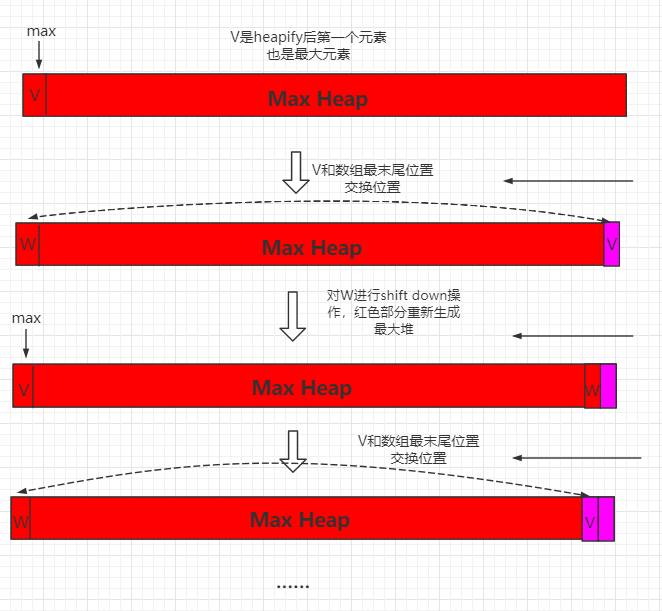
5.13.1. Java instance code 
Src/runoob/heap/HeapSort.java file code: 
package runoob.heap;
import runoob.sort.SortTestHelper;
/*\*
\* 原地堆排序
*/
public class HeapSort
Principles, Technologies, and Methods of Geographic Information Systems
102