
In this chapter, we will introduce Django management tools and how to use Django to create a project. For the first project, we use HelloWorld to command the project.
Test version notes:
Python 3.7.4
Django 3.0.6
7.4.1. Django management tools 
After installing Django, you should now have an available administrative tool django-admin,Windows that can be used with django-admin if you don’t have an environment variable configured.
We can take a look at the command introduction of django-admin:
$ django-admin
Type 'django-admin help ' for help on a specific subcommand.
Available subcommands:
[django]
check
compilemessages
createcachetable
dbshell
diffsettings
dumpdata
flush
inspectdb
loaddata
makemessages
makemigrations
migrate
runserver
sendtestemail
shell
showmigrations
sqlflush
sqlmigrate
sqlsequencereset
squashmigrations
startapp
startproject
test
testserver
……省略部分……
7.4.2. Create the first project 
Use django-admin to create a HelloWorld project:
django-admin startproject HelloWorld
After the creation is complete, we can view the directory structure of the project below:
$ cd HelloWorld/
$ tree
.
|-- HelloWorld
| |-- __init__.py
| |-- asgi.py
| |-- settings.py
| |-- urls.py
| `-- wsgi.py
`-- manage.py
Catalog description:
-
HelloWorld: The container for the project.
-
manage.py: A practical command line tool that allows you to interact with the Django project in a variety of ways.
-
HelloWorld/__init__.py: An empty file that tells Python that the directory is a Python package.
-
HelloWorld/asgi.py: A portal to an ASGI-compatible Web server to run your project.
-
HelloWorld/settings.py: The settings / configuration of the Django project.
-
HelloWorld/urls.py: The URL statement of the Django project; a website “directory” driven by Django.
-
HelloWorld/wsgi.py: A portal to a WSGI-compatible Web server to run your project.
Next, let’s enter the HelloWorld directory and enter the following command to start the server:
python3 manage.py runserver 0.0.0.0:8000
0.0.0.0 allows other computers to connect to the development server, with 8000 as the port number. If not, the port number defaults to 8000.
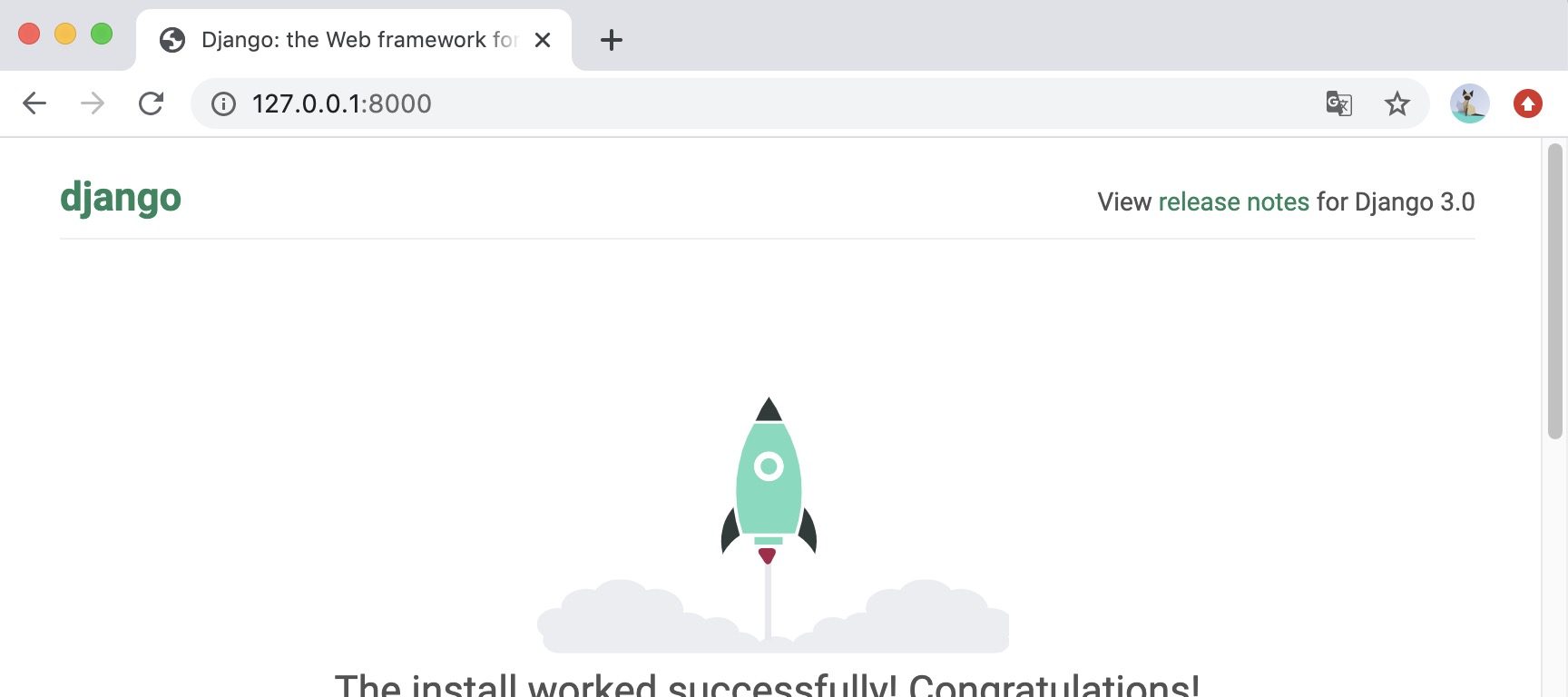
Enter the ip of your server in the browser (here we enter the local IP address: 127.0.0.1:8000 ) and port number. If it starts normally, the output result is as follows:
7.4.3. View and URL configuration 
Create a new views.py file in the HelloWorld directory under the previously created HelloWorld directory, and enter the code:
HelloWorld/HelloWorld/views.py file code: 
fromdjango.httpimportHttpResponsedefhello(request):returnHttpResponse("Hello
world !")
Next, bind the URL to the view function. Open the urls.py file, delete the original code, and copy and paste the following code into the urls.py file:
HelloWorld/HelloWorld/urls.py file code: 
fromdjango.conf.urlsimporturlfrom.importviewsurlpatterns=[url(r'^$',views.hello),]
The whole directory structure is as follows:
$ tree
.
|-- HelloWorld
| |-- __init__.py
| |-- __init__.pyc
| |-- settings.py
| |-- settings.pyc
| |-- urls.py # url 配置
| |-- urls.pyc
| |-- views.py # 添加的视图文件
| |-- views.pyc # 编译后的视图文件
| |-- wsgi.py
| `-- wsgi.pyc
`-- manage.py
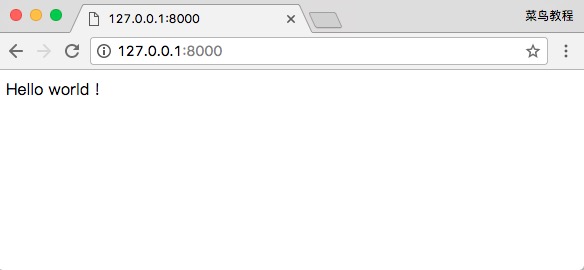
When you are finished, start the Django development server, and open the browser in the browser and visit:
We can also modify the following rules:
HelloWorld/HelloWorld/urls.py file code: 
fromdjango.urlsimportpathfrom.importviewsurlpatterns=[path('hello/',views.hello),]
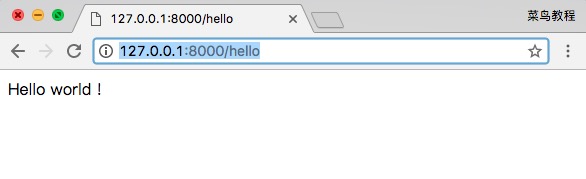
Open it through a browser http://127.0.0.1:8000/hello The output is as follows:
注意: If the code changes in the project, the server will automatically monitor the code changes and reload automatically, so if you have started the server, you do not need to restart manually.
7.4.4. Path () function 
Django path () can accept four parameters, two required parameters: route, view, and two optional parameters: kwargs, name.
Syntax format:
path(route, view, kwargs=None, name=None)
-
Route: a string that represents the URL rule, and the matching URL executes the corresponding second parameter, view.
-
View: used to execute URL requests that match regular expressions.
-
Kwargs: the parameter of the dictionary type used by the view.
-
Name: used to get URL in reverse.
Django2. The re_path () method can be used in 0 to be compatible with the url() Method, some regular expression rules can also be implemented through re_path ().
from django.urls import include, re_path
urlpatterns = [
re_path(r'^index/$', views.index, name='index'),
re_path(r'^bio/(?P\w+)/$', views.bio, name='bio'),
re_path(r'^weblog/', include('blog.urls')),
...
]
-
1. Sqlite
47
-
1. SVG tutorial
19
-
1. C# tutorial
61
-
1. Memcached
20
-
1. Angularjs2
8
-
2. Vue3
19
-
2. Go
43
-
2. Servlet
21
-
2. Docker
59
-
3. React
23
-
3. Kotlin
18
-
3. Mongodb
44
-
3. Android
18
-
3. SOAP tutorial
10
-
4. Lua
31
-
4. Appml
12
-
4. MySQL tutorial
34
-
5. Perl
45
-
web
15
-
5. Postgresql
41
-
6. Ruby
41
-
5. Web Services tutorial
6
-
6. Design-pattern
35
-
7. Rust
22
-
6. WSDL tutorial
8
-
7. Django
18
-
8. Foundation
39
-
9. Ios
43
-
9. Swift
43
-
8. Css3
26
-
11. HTML tutorial-(HTML5 Standard)
54
-
12. Http
6
-
13. Regex
6
-
14. Regexp
7
-
1. Geographical Information Systems in the World Wide Web Era
4
-
2. Basic technology of WebGIS
4
-
3. Geographic Web Services
5
-
4. aggregation of geographical information
4
-
5. mobile GIS
5
-
6. Geographic information portal
3
-
7. New generation national spatial data infrastructure and GIS
4
-
8. Application of WebGIS in E-Commerce
3
-
9. Application of WebGIS in E-government
3
-
10. Hotspots and frontiers of WebGIS
2
Principles, Technologies, and Methods of Geographic Information Systems
102
In recent years, Geographic Information Systems (GIS) have undergone rapid development in both theoretical and practical dimensions. GIS has been widely applied for modeling and decision-making support across various fields such as urban management, regional planning, and environmental remediation, establishing geographic information as a vital component of the information era. The introduction of the “Digital Earth” concept has further accelerated the advancement of GIS, which serves as its technical foundation. Concurrently, scholars have been dedicated to theoretical research in areas like spatial cognition, spatial data uncertainty, and the formalization of spatial relationships. This reflects the dual nature of GIS as both an applied technology and an academic discipline, with the two aspects forming a mutually reinforcing cycle of progress.
-
1. Introduction to Geographic Information Systems
6
-
2. From the Real World to the Bit World
3
-
3. Spatial Data Model
7
-
4. Spatial Reference Systems and Map Projections
5
-
5. Data in GIS
4
-
6. Spatial data acquisition
2
-
7. Spatial Data Management
6
-
8. Spatial analysis
8
-
9. Digital Terrain Model (DTM) and Terrain Analysis
5
-
10. Spatial modeling and spatial decision support
6
-
11. Spatial data representation and map making
6
-
12. 3S Integration Technology
5
-
13. Network Geographic Information System
4
-
14. Examples of Geographic Information System Application
8
-
15. Organization and Management of Geographic Information System Application Projects
10
-
16. Geographic Information system Software Engineering Technology
7
-
17. Geographic Information System Standards
3
-
18. Geographic Information System and Society
3
-
19. Earth Information Science and Digital Earth
4