最近几年来,地理信息系统无论是在理论上还是应用上都处在一个飞速发展的阶段。 GIS被应用于多个领域的建模和决策支持,如城市管理、区划、环境整治等等,地理信息成为信息时代重要的组成部分之一; “数字地球”概念的提出,更进一步推动了作为其技术支撑的GIS的发展。 与此同时,一些学者致力于相关的理论研究,如空间感知、空间数据误差、空间关系的形式化等等。 这恰好说明了地理信息系统作为应用技术和学科的两个方面,并且这两个方面构成了相互促进的发展过程。
The Observer pattern (Observer Pattern) is used when there is an one-to-many relationship between objects. For example, when an object is modified, objects that depend on it are automatically notified. The observer model belongs to the behavioral model. 意图: Define an one-to-many dependency between objects. When the state of an object changes, all objects that depend on it are notified and updated automatically. 主要解决: The problem of notifying other objects of a change in the state of one object, and taking into account ease of use and low coupling to ensure a high degree of collaboration. 何时使用: The state of an object (target object) changes, and all dependent objects (observer objects) will be notified for broadcast notification. 如何解决: Using object-oriented technology, this dependency can be weakened. 关键代码: In the abstract class there is an ArrayList for observers. 应用实例: 1. During the auction, the auctioneer observes the highest bid and then notifies other bidders of the bid. 2. In the Journey to the West, Wukong asked the Bodhisattva to surrender the Red Bodhisattva. The Bodhisattva sprinkled water to attract an old tortoise. The tortoise was the observer. He observed the Bodhisattva’s act of sprinkling water. 优点: 1. The observer and the observed are abstract and coupled. 2. Establish a set of trigger mechanism. 缺点: 1. If an observed object has many direct and indirect observers, it will take a lot of time to notify all the observers. 2. If there is a circular dependency between the observer and the observation target, the observation target will trigger a circular call between them, which may cause the system to crash. 3. The observer model has no corresponding mechanism to let the observer know how the observed object has changed, but only knows that the observed object has changed. 使用场景: An abstract model has two aspects, one of which depends on the other. Encapsulate these aspects in separate objects so that they can be changed and reused independently. The change of one object will lead to the change of one or more other objects, but we don’t know how many objects will change, which can reduce the coupling between objects. An object must notify other objects without knowing who those objects are. You need to create a trigger chain in the system, the behavior of An object will affect B object, and the behavior of B object will affect C object. You can use observer mode to create a chained trigger mechanism 注意事项: 2. Avoid circular references. 3. If executed sequentially, an observer error will cause the system to jam, usually in an asynchronous way. The observer mode uses three classes, Subject, Observer, and Client. The Subject object has methods to bind the observer to and unbind the observer from the Client object. We create Subject Class, Observer Abstract classes and extension of abstract classes Observer The entity class of the ObserverPatternDemo Our demo class uses the Subject And entity class objects to demonstrate the observer pattern. Create the Subject class. Create the Observer class. Create an entity observer class. Use Subject And physical observer objects. Execute the program and output the result: 6.22.1. Introduction 
6.22.2. Realize 
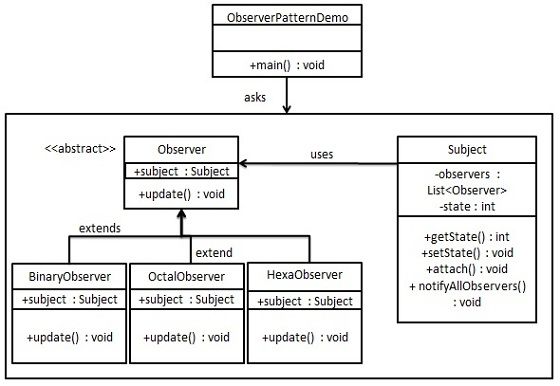
6.22.3. Step 1 
Subject.java 
importjava.util.ArrayList;importjava.util.List;publicclassSubject{privateList<Observer>observers=newArrayList<Observer>();privateintstate;publicintgetState(){returnstate;}publicvoidsetState(intstate){this.state=state;notifyAllObservers();}publicvoidattach(Observerobserver){observers.add(observer);}publicvoidnotifyAllObservers(){for(Observerobserver:observers){observer.update();}}}
6.22.4. Step 2 
Observer.java 
publicabstractclassObserver{protectedSubjectsubject;publicabstractvoidupdate();}
6.22.5. Step 3 
BinaryObserver.java 
publicclassBinaryObserverextendsObserver{publicBinaryObserver(Subjectsubject){this.subject=subject;this.subject.attach(this);}@Overridepublicvoidupdate(){System.out.println("Binary String:"+Integer.toBinaryString(subject.getState()));}}
OctalObserver.java 
publicclassOctalObserverextendsObserver{publicOctalObserver(Subjectsubject){this.subject=subject;this.subject.attach(this);}@Overridepublicvoidupdate(){System.out.println("Octal String:"+Integer.toOctalString(subject.getState()));}}
HexaObserver.java 
publicclassHexaObserverextendsObserver{publicHexaObserver(Subjectsubject){this.subject=subject;this.subject.attach(this);}@Overridepublicvoidupdate(){System.out.println("Hex String:"+Integer.toHexString(subject.getState()).toUpperCase());}}
6.22.6. Step 4 
ObserverPatternDemo.java 
publicclassObserverPatternDemo{publicstaticvoidmain(String[]args){Subjectsubject=newSubject();newHexaObserver(subject);newOctalObserver(subject);newBinaryObserver(subject);System.out.println("First state change: 15");subject.setState(15);System.out.println("Second state change: 10");subject.setState(10);}}
6.22.7. Step 5 
First state change: 15 Hex String: F Octal String: 17 Binary String: 1111 Second state change: 10 Hex String: A Octal String: 12 Binary String: 1010