Sometimes, we may need to execute the same piece of code multiple times. In general, statements are executed sequentially: the first statement in the function is executed first, then the second statement, and so on.
Programming languages provide a variety of control structures for more complex execution paths.
Loop statements allow us to execute a statement or group of statements multiple times. Here is a flowchart of loop statements in most programming languages:
The Scala language provides the following loop types. Click the link to viewthe details of each type. Cycle type Description While cycle Run a series of statements that, if the condition is true, run repeatedly until the condition becomes false. Do…while cycle A similar while statement differs from a block of code that executes a loop before determining a loop condition. for cycle Used to repeat a series of statements until specific conditions are met, usually by increasing the value of the counter after each loop is completed. Loop control statements change the order in which your code is executed, through which you can jump the code. Scala has the following loop control statements: Scala does not support Control statement Description Break statement Break cycle If the condition is always the The post-execution loop of the above code will be executed forever, and you can use the Ctrl + C key to break the infinite loop.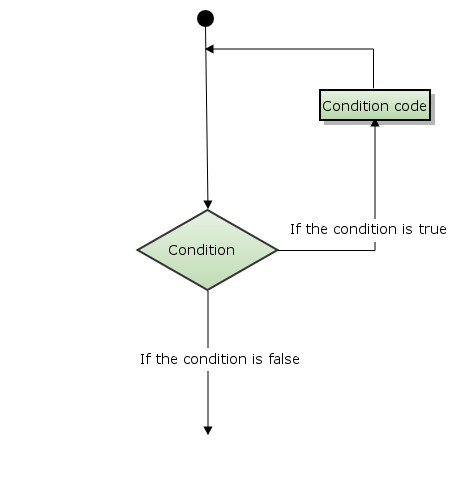
8.10.1. Cycle type #
8.10.2. Loop control statement #
break or continue statement, but a way to break the loop has been provided since version 2.8. Click the link below fordetails. 8.10.3. Infinite cycle #
true loop becomes an infinite loop We can use it. while statement to implement an infinite loop:Example #
object Test { def main(args: Array[String]) { var a = 10; // Infinite loop while( true ){ println( "The value of a is : " + a ); } } }