
To use mongodb in php, you must use mongodb’s php driver.
For the installation of MongoDB PHP on each platform and the download of the driver package, please see: PHP安装MongoDB扩展驱动
If you are using PHP7, please see: PHP7 MongoDB 安装与使用 . To ensure a correct connection, you need to specify the database name. If the database does not exist in mongoDB, mongoDB will automatically create it. The code snippet is as follows: The code snippet to create the collection is as follows: Execute the above procedure, and the output is as follows: Use in mongoDB Insert the document code snippet as follows: Execute the above procedure, and the output is as follows: Then we use the db.runoob.find (). Pretty (); command on the mongo client to view the data: Use The code snippet that reads the usage document is as follows: Execute the above procedure, and the output is as follows: Use The following example updates the document titled ‘MongoDB tutorial’ with the following code snippet: Execute the above procedure, and the output is as follows: Then we use it on the mongo client Use In the following example, we will remove a data record where ‘title’ is the MongoDB tutorial’. The code snippet is as follows: 除了以上实例外,在php中你还可以使用 For more methods of operation, refer to the Mongodb core class: http://php.net/manual/zh/mongo.core.php .
In recent years, Geographic Information Systems (GIS) have undergone rapid development in both theoretical and practical dimensions. GIS has been widely applied for modeling and decision-making support across various fields such as urban management, regional planning, and environmental remediation, establishing geographic information as a vital component of the information era. The introduction of the “Digital Earth” concept has further accelerated the advancement of GIS, which serves as its technical foundation. Concurrently, scholars have been dedicated to theoretical research in areas like spatial cognition, spatial data uncertainty, and the formalization of spatial relationships. This reflects the dual nature of GIS as both an applied technology and an academic discipline, with the two aspects forming a mutually reinforcing cycle of progress. 3.29.1. Make sure you connect and select a database 
test; // 获取名称为 "test" 的数据库
?>
Create a collection 
test; // 获取名称为 "test" 的数据库
$collection = $db->createCollection("runoob");
echo "集合创建成功";
?>
集合创建成功
Insert document 
insert() Method to insert the document:test; // 选择一个数据库
$collection = $db->runoob; // 选择集合
$document = array(
"title" => "MongoDB",
"description" => "database",
"likes" => 100,
"url" => "http://www.runoob.com/mongodb/",
"by", "菜鸟教程"
);
$collection->insert($document);
echo "数据插入成功";
?>
数据插入成功
Find a document 
find() Method to read the documents in the collection.test; // 选择一个数据库
$collection = $db->runoob; // 选择集合
$cursor = $collection->find();
// 迭代显示文档标题
foreach ($cursor as $document) {
echo $document["title"] . "\n";
}
?>
MongoDB
Update document 
update() Method to update the document.
test; // 选择一个数据库
$collection = $db->runoob; // 选择集合
// 更新文档
$collection->update(array("title"=>"MongoDB"), array('$set'=>array("title"=>"MongoDB 教程")));
// 显示更新后的文档
$cursor = $collection->find();
// 循环显示文档标题
foreach ($cursor as $document) {
echo $document["title"] . "\n";
}
?>
MongoDB 教程
db.runoob.find().pretty() ; command to view data: 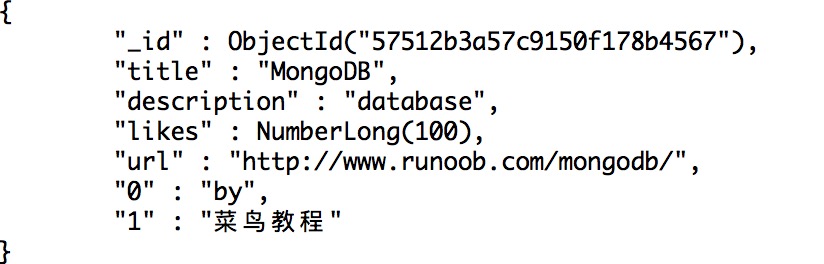
Delete document 
remove() Method to delete the document. test; // 选择一个数据库
$collection = $db->runoob; // 选择集合
// 移除文档
$collection->remove(array("title"=>"MongoDB 教程"), array("justOne" => true));
// 显示可用文档数据
$cursor = $collection->find();
foreach ($cursor as $document) {
echo $document["title"] . "\n";
}
?>
findOne() , save() , limit() , skip() , sort() 等方法来操作Mongodb数据库。
Principles, Technologies, and Methods of Geographic Information Systems
102